
You met three weeks ago. You are already texting good morning and good night, already saying you have never felt this way before, already picturing them at Thanksgiving. It feels like the realest thing that has ever happened to you.
It might be. It also might not be, and the difference matters more than the speed does. Most of what gets written about falling in love fast is either a warning to be scared of it or a romance-novel celebration of it. Neither is that useful. What actually helps is knowing what is happening in your body and your history when it hits, so you can tell which version of fast you are in.
What falling in love fast actually feels like
Psychologists have a name for the specific, obsessive intensity of an instant crush. It is called limerence, an involuntary state of near-constant intrusive thinking about one person, powered by anxiety and a desperate need for that person to feel the same way back [1]. Limerence is not the same thing as love. Love, even fast love, tends to feel calm underneath the excitement. Limerence feels like a low-grade emergency you cannot turn off.
The tell is what is driving the feeling. Real fast connection is driven by genuine fit, shared humor, aligned values, an easy way of being around each other. Limerence is driven by desire, uncertainty, and a hunger for validation [1]. You can be limerent about someone you barely know anything about. You cannot actually love someone you barely know anything about, no matter how good it feels in the moment.
What is actually happening in your brain
There is a physical reason this feels so overwhelming, and it has nothing to do with willpower. In 2005, researcher Helen Fisher and colleagues put people who had just fallen intensely in love into an fMRI scanner and showed them a photo of their new partner [2]. The scans lit up in the same dopamine-rich reward and motivation circuitry, the ventral tegmental area and the caudate nucleus, that activates during other powerful cravings [2]. New romantic love does not just feel like a drive. In a measurable, physical sense, it partly is one.
Fisher's broader research frames this as one of three separate brain systems humans evolved for mating and bonding: sex drive, romantic love, and long-term attachment [2]. They are related but not identical, and they do not all switch on at the same speed. The romantic-love system, the dopamine-driven one, can fire almost instantly on very little information. The attachment system, the one that actually predicts whether a relationship survives, builds much more slowly, through repeated real experience with a specific person.
This matters practically because the two systems give you different information at different speeds. The romantic-love system can tell you, almost immediately, that someone has your attention in a way few people do. It cannot tell you whether they are patient, whether they keep their word, or whether they handle a bad week without taking it out on you. Only the slower attachment system, built from actual shared experience, answers those questions, which is exactly why the research timelines above run in months, not days.
The rush you feel in week one is a real brain system doing its job. It is just the wrong system to trust for a verdict on compatibility.
The real timeline, according to the research
Here is the part that surprises people. A study in the Journal of Social Psychology asked daters when they first felt love for a partner and found men reported it at an average of 88 days in, women closer to 134 days [3]. Three months to four and a half months, not three weeks.
That gap between the two timelines is not a coincidence, and it is not really about how fast someone falls, it is about how long it took the attachment system, not just the dopamine system, to catch up and confirm the feeling. That does not mean everyone who feels something at three weeks is wrong. It means three weeks is early enough that what you are feeling is more likely to be the opening rush than the settled thing. The rush is real. It is just not yet evidence of compatibility, because you have not had enough real interactions to gather that evidence.
Three weeks tells you how someone makes you feel. Three months starts telling you who they actually are.
Some people are wired to fall fast, and it has a name
Not everyone experiences this the same way. Psychologist Daniel Jones coined the term emophilia to describe a stable personality trait, the tendency to fall in love easily, quickly, and often, sometimes with multiple people in the same year [4]. People high in emophilia are not confused or naive. They are chasing something specific, the euphoria and novelty of new romantic connection itself, almost independent of who the person turns out to be [4].
Jones draws a sharp distinction that is worth sitting with. Anxious attachment is a need-based pattern, using a relationship to soothe an old fear of abandonment. Emophilia is a want-based pattern, chasing the high of falling itself [4]. They can overlap, and research does show a moderate link between the two, but they are not identical. One person might fall fast because they are scared of being alone. Another falls fast because the feeling of falling is the thing they are actually addicted to. Either way, the falling itself tells you very little about whether the person on the other end is right for you.
How to tell fast love from love bombing
There is a third possibility, and it is the one worth being genuinely cautious about. Love bombing is when someone overwhelms a new partner with excessive attention, constant contact, extravagant gifts, and grand declarations, usually concentrated in the first two to four weeks [5]. It looks identical to enthusiastic real interest from the outside, and often from the inside too. The difference shows up later. Once someone using love bombing feels they have secured your attachment, the intensity frequently reverses into criticism, withdrawal, or control [5].
The practical test is not how intense the first month felt. It is what happens in month two. Real fast connection tends to deepen and stabilize. Love bombing tends to spike hard and then flip. If the person who could not stop texting you in week one is suddenly cold, critical, or checked out by week six, that pattern is data, not a mood swing to explain away.
Why this connects to attachment style
We wrote previously about how attachment style shapes dating in Tulsa, and falling-fast intensity connects directly to that picture. Adult attachment theory, first mapped by Hazan and Shaver in 1987, holds that anxious attachment develops from inconsistent early caregiving and shows up in adulthood as heightened sensitivity to closeness and abandonment [6]. People with anxious attachment often report the most intense, fastest-moving early relationship feelings, because a new partner's attention temporarily quiets an old, familiar fear.
That does not make the feeling fake. It makes it worth separating from the question of fit. You can be anxiously attached and still find someone genuinely right for you. The three-week intensity just is not, by itself, proof that you have. It is proof that your nervous system is responding to attention, which is a different thing.
Why Tulsa's dating pool makes fast feel urgent
There is a local wrinkle to all of this that is worth naming. Tulsa and the surrounding suburbs are mid-sized markets, which means the dating pool cycles faster than it does in a bigger city. You meet someone who feels genuinely new, who has not already dated three people you know, and there is a real temptation to grab onto that novelty and lock it down before the pool shrinks again.
That pressure is understandable and it is exactly the wrong reason to skip the part where you actually learn who someone is. A small dating pool makes a good match feel rarer than it is, and that scarcity feeling activates the same reward circuitry the fMRI research picked up, on top of whatever the person themselves is generating. You end up falling not just for them, but partly for the relief of not having to keep searching. Those two feelings are easy to confuse and worth pulling apart before you build plans around either one.
What we watch for at Cabin Boys
This is exactly why we built the SPARK Quiz around five compatibility dimensions instead of one feeling. Attachment pattern is one of the five, alongside social energy, partnership values, relationship vision, and conflict style [7]. A guest who runs hot and fast is not a problem for us. We just do not want their first data point to be the only data point.
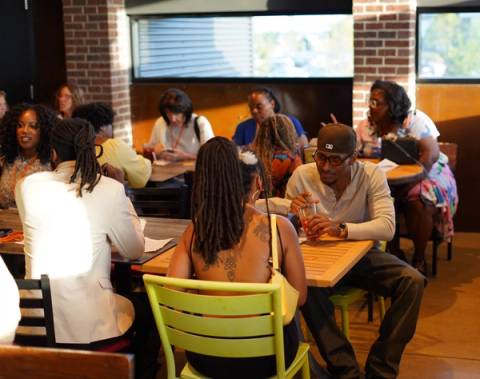
Every guest at a Beyond The Sparks event has already been matched on more than chemistry before they sit down at Cabin Boys Brewpub. So when something clicks fast in the room, and it does, regularly, it is clicking on top of a values and attachment fit that already checked out, not instead of one. That is a meaningfully different kind of fast. The spark still needs to be real. It is just not the only thing carrying the weight.
We have watched this play out in real time at events. Two guests sit down, and within a few minutes the table has that unmistakable electricity, leaning in, losing track of the room around them. The difference between that being a real fast connection and a limerent one is not visible that same night. It shows up over the next month, in whether the conversation keeps deepening or whether it was mostly the newness talking. Pre-matching does not make that answer come faster. It just means the two people finding out are already more likely to be compatible underneath the spark, so the answer is more often a good one.
A quick way to tell which one you are in
A few honest questions, if you are three weeks into something that feels enormous right now.
Does the intensity come with calm underneath it, or with constant low-grade anxiety about where you stand? Limerence runs on uncertainty. Real early connection, even an intense one, tends to come with a baseline sense of ease.
Has the pace been driven by both of you, or mostly by them? Genuine fast connection usually looks mutual and slightly startled on both sides. Love bombing is frequently one-directional and deliberate, even if it does not feel deliberate from the receiving end.
What do you actually know about their values, not their charm? If you could not answer a specific question about how they handle conflict, what they want in two years, or how they treat people who cannot do anything for them, the connection you are feeling has outpaced the information you have.
Would the feeling survive a slower pace? If the idea of taking two more weeks before the next big step feels unbearable rather than just mildly disappointing, that urgency itself is worth examining separately from the person causing it.
None of this means slow down out of fear
If you take one thing from the research, let it be this. Speed and depth are not opposites, but they are not the same axis either. You can have a fast, deep connection. You can also have a fast, shallow one that feels identical for the first month. The only way to know which you have is to let enough real time and real friction pass that the attachment system gets a vote, not just the dopamine system.
We are not telling you to distrust every fast feeling. Some of the strongest relationships we have seen come out of Beyond The Sparks moved quickly and turned out completely real. The point is not speed. The point is knowing what is actually generating the speed before you build a life around it.
That is easier when the person across the table has already been filtered for values and attachment fit before the first spark even happens. Take the SPARK Quiz at beyondthesparks.com. Five minutes, and it asks the questions that separate a fast real connection from a fast intense one.
We will see you at Cabin Boys.
Sources
1. Psychology Today, "Limerence" overview and "The Folly of Falling in Love Too Quickly," July 2025. https://www.psychologytoday.com/us/blog/why-bad-looks-good/202507/the-folly-of-falling-in-love-too-quickly
2. Harvard Medical School, "Love and the Brain" (Fisher, Aron, Brown fMRI research on romantic love). https://hms.harvard.edu/news-events/publications-archive/brain/love-brain
3. MindBodyGreen, "How Long Does It Take To Fall In Love? What Research Says." https://www.mindbodygreen.com/articles/how-long-it-takes-to-fall-in-love
4. PsyPost, "Emophilia: The psychology of falling in love quickly" (Daniel Jones research). https://www.psypost.org/emophilia-the-psychology-of-falling-in-love-quickly/
5. Attachment Project, "What is Limerence? Definition and Stages." https://www.attachmentproject.com/love/limerence/
6. Hazan, C., and Shaver, P., "Romantic Love Conceptualized as an Attachment Process," 1987, overview via R. Chris Fraley, University of Illinois. https://labs.psychology.illinois.edu/~rcfraley/attachment.htm
7. Beyond The Sparks, "How the SPARK Profile Predicts Real Chemistry." https://beyondthesparks.com/blog/how-spark-profile-predicts-chemistry
Frequently Asked Questions
Not automatically. Fast connection is only a concern when the intensity is not backed by real information about the other person's values and character. The research puts the average timeline for reported love at 88 days for men and 134 days for women, which is a useful check, not a rule.
Limerence is driven by anxiety, uncertainty, and a need for validation, and it can happen with someone you barely know. Real love is driven by actual fit and tends to feel calmer underneath the excitement, even when it is happening quickly.
Watch what happens after the first month, not during it. Love bombing typically peaks in the first two to four weeks and then reverses into criticism or withdrawal once the person feels they have secured your attachment. Genuine fast connection tends to deepen instead of flip.
Yes. Attachment pattern is one of the five SPARK dimensions, and it is designed to surface how someone handles closeness and pace, not to penalize intensity. The goal is matching you with people whose pace and values line up with yours before the first spark happens.
Ready to Find Your Match in Tulsa?
Take the free SPARK Quiz and join us at our next event. Everyone leaves with at least one match.
Next event · Singles Bash: Halloween Game Night for Tulsa Singles · Friday, October 30 · Tulsa · from $25.00 Reserve →
Start Your Free SPARK Quiz →