Most dating apps run on two filters. Are you nearby, and do you look good in a photo. That is basically the whole algorithm, and it explains why the average user burns ninety minutes a day swiping and still goes on fewer than two dates a month. The math is brutal. People are spending more time on dating than at any point in recorded history and getting less out of it.
We built the SPARK Quiz to flip that ratio. Five minutes of honest answers, five dimensions of compatibility, and one SPARK Profile that we actually use to seat you across from someone you have a real shot with. Not someone who passed a photo test. Someone whose values, attachment style, and weekend energy line up with yours.
This post walks through the five dimensions. What each one measures, the research behind it, and what it looks like in the room at our Cabin Boys events in downtown Tulsa.
Why pre-matching beats swiping
Before we get into the dimensions, the bigger question. Why do this at all when apps already exist.
The honest answer comes from the researchers who study this for a living. Eli Finkel and his team reviewed the entire online dating industry and found no compelling evidence that any matching algorithm actually works [1]. The apps that promise science are mostly selling vibes. Finkel's argument is sharper than that, even. He says the algorithms cannot work in principle, because the traits they measure are not the traits that predict whether two people will build something real.
Samantha Joel and Paul Eastwick ran a different kind of study. They threw machine learning at decades of couples data across forty-three longitudinal studies and asked what self-report variables actually predict relationship quality [2]. The answer was humbling. Individual traits matter less than the relationship-specific story two people build together. But the strongest predictors that did show up were things like attachment patterns, perceived partner commitment, and conflict style. The exact stuff apps never ask about.
Their 2022 PNAS follow-up found something else worth knowing. First impressions of compatibility, measured before two people even go on a date, predict romantic interest months later [3]. The signal is there early. You just have to ask the right questions to find it.
That is what the SPARK Quiz does. Ask the right questions, use the answers, put you in the same room as people the answers actually point to. Then let chemistry do its job in person, which is where chemistry has always lived anyway.
S is for Social Energy Style
The first dimension is the one most couples fight about without realizing they are fighting about it. How much social input do you need to feel alive, and how much alone time do you need to feel whole.
This is not the cartoon version of introvert versus extrovert. It is closer to what personality researchers call extraversion within the Big Five framework, one of the most replicated frameworks in psychology [4]. Extraversion shapes how often you want to be around people, what kind of stimulation feels good, and what you do on a Sunday when nothing is planned.
Mismatched social energy looks like this. One partner books every Friday with friends. The other partner is bracing for a quiet night and finds out at six that the plans changed. Nobody is wrong. They just need different things from the same week.
The SPARK Quiz figures out where you genuinely land, not where you wish you landed. We seat high-energy social types near each other and quieter recharge-at-home types near each other. At a Cabin Boys event you can feel this within ten minutes. The conversation has the same temperature on both sides of the table.
P is for Partnership Values
This is the boring stuff that turns out not to be boring at all.
What do you actually need from a partner day to day. How do decisions get made in your house. Do you want kids, and on what timeline. How do you feel about money, ambition, religion, family obligations. The values layer.
Apps do not ask this because values are not photogenic. But values are where long-term compatibility lives. The Joel and Eastwick machine-learning work found that perceptions of shared values and life goals were among the most consistent predictors of relationship satisfaction across forty-three datasets [2]. You can have chemistry with someone whose values are misaligned. You cannot build a life with them.
We weight this dimension heavily because it is the one that fails quietly. Two people get along, the dates feel easy, six months in someone realizes the other person does not want kids and never did. That is a preventable heartbreak. The SPARK Profile surfaces values mismatches before anyone has invested half a year finding out the hard way.
At a Cabin Boys event this shows up as a different quality of conversation. People are not interviewing each other. They already know the basics line up, so they can spend the night getting to the texture of who someone is.
A is for Attachment Patterns
Attachment is the dimension that quietly runs everything.
Hazan and Shaver took John Bowlby's infant attachment research and extended it to adult romance back in 1987, arguing that the way we bond with partners runs on the same behavioral system that ran our earliest relationships [5]. R. Chris Fraley has spent decades refining that picture. The short version is that most adults fall somewhere across two axes. How anxious you get about closeness and abandonment, and how much you avoid emotional closeness in the first place.
Securely attached people sit low on both axes. They handle conflict without panicking, take in reassurance when it arrives, and offer it without resentment. Anxious folks need more contact and more reassurance. Avoidant folks need more space and pull back when things get intense. None of these styles are broken. They just need different responses from a partner.
The trouble starts when an anxious person pairs with an avoidant one and they trigger each other for years without naming what is happening. The SPARK Quiz reads attachment signals from how you describe past relationships and how you respond to closeness scenarios. We match for compatibility on this axis specifically, because it is the dimension that predicts how a couple will handle the stuff that will inevitably go sideways.
What this looks like at Cabin Boys is hard to see and easy to feel. The pairs we seat tend to settle into each other quickly. There is less of the bracing energy you sometimes get on a first date, where both people are waiting for the other shoe.
R is for Relationship Vision
Where are you going, and how fast.
This is the dimension that filters for life-stage compatibility. Someone who wants to be engaged within two years and someone who is not sure they want to get married at all are going to experience the same relationship very differently. Both can be lovely people. They are just not lovely for each other right now.
Eli Finkel's work on online dating points at this gap as one of the biggest blind spots in app-based matching [1]. Apps ask if you want a relationship. They do not ask on what timeline, with what structure, leading to what kind of life. So people show up to first dates with wildly different definitions of what the date is even for.
The SPARK Quiz asks specifically about timeline and structure. Marriage versus long partnership. Kids on a clock or open-ended. City life or eventual move. We match people whose visions point in roughly the same direction so the early conversations can be about getting to know each other instead of doing covert compatibility math.
This is the dimension Tulsa singles tell us they care about most. People in their late twenties and thirties are tired of dating without a destination. They want to know the person across the table is at least pointed the same way.
K is for Key Conflict and Connection Style
The original SPARK frame called this Key Love Language, and Gary Chapman's love languages are still a useful shorthand for how people show and receive care [6]. Acts of service. Words of affirmation. Quality time. Physical touch. Gifts. Most folks lead with one or two and feel a little starved when their partner leads with different ones.
But we expanded this dimension after looking at what predicts long-term satisfaction in the research. Love language alignment matters. Conflict style matters more.
John Gottman spent forty years filming couples in his lab and found he could predict divorce with over ninety percent accuracy by watching fifteen minutes of conflict [7]. The four patterns that did the predicting are now famous. Criticism, contempt, defensiveness, and stonewalling. Contempt was the single strongest signal. Couples who fight with contempt do not last.
The flip side is that couples who fight with curiosity, who repair quickly, who can name what they need without making the other person wrong, tend to be the ones who go the distance. The SPARK Quiz reads both sides of this dimension. How you give and receive love when things are calm, and how you handle friction when they are not.
We match people whose conflict styles can actually metabolize each other. A direct communicator paired with someone who shuts down under pressure is a slow-motion problem. A direct communicator paired with another direct communicator can fight cleanly and be done in twenty minutes.
At a Cabin Boys event you will not see conflict styles play out, obviously. Everyone is on their best behavior on a first date. But you will feel the absence of the wrong friction. The conversations move.
How the dimensions stack
Each dimension on its own gives a partial picture. Stacked together they give us something much closer to a real compatibility read.
Big Five research backs this up. The trait combinations that predict the highest relationship satisfaction are low neuroticism with high conscientiousness and high agreeableness, not any one trait on its own [4]. Compatibility is multiplicative. Two people can be wonderful on four dimensions and the fifth can still sink them.
We do not promise perfect matches. Nobody can. What we promise is that the people you meet at a Cabin Boys event have been filtered for the five dimensions that the actual relationship science says matter most. The rest is up to you and a pint of something local.
What this looks like at Cabin Boys
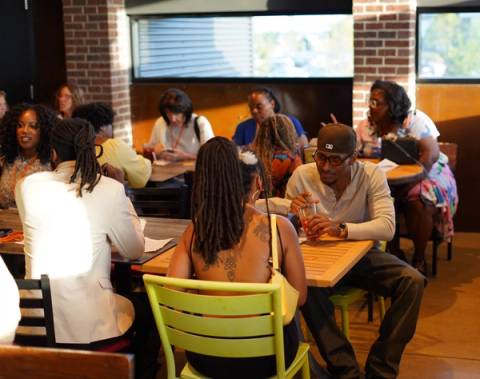
The venue is 223 N Main Street in the Tulsa Art District. Cabin Boys Brewpub. We picked it because the room has the right temperature for what we are trying to do, which is help strangers turn into people who recognize each other.
Every guest in the room took the SPARK Quiz before the night. Every seating chart is built from the data. You are not meeting random singles. You are meeting people whose social energy, values, attachment, vision, and conflict style line up with yours in ways that took us five minutes to find and would have taken you five months.
When the night ends, everyone leaves with at least one match. Not a phone number you may or may not text. A confirmed mutual match the system surfaces after the event closes, with a clean way to reach out and a real reason to do it.
That is the whole pitch. We did the boring matching work in advance so the night itself can be about the part that matters. Two people across a small table figuring out if the chemistry the data predicted is the chemistry that actually lands.
Take the SPARK Quiz at beyondthesparks.com. Five minutes. Then come find out what the data was pointing at.
Sources
[1] Finkel, E. J., Eastwick, P. W., Karney, B. R., Reis, H. T., Sprecher, S. (2012). Online Dating, A Critical Analysis From the Perspective of Psychological Science. Psychological Science in the Public Interest. https://www.psychologicalscience.org/uncategorized/q-a-with-eli-finkel-the-science-behind-online-dating-part-1.html
[2] Joel, S., Eastwick, P. W., et al. (2020). Machine learning uncovers the most reliable self-report predictors of relationship quality across 43 longitudinal couples studies. PNAS. https://www.pnas.org/doi/10.1073/pnas.1917036117
[3] Eastwick, P. W., Joel, S., et al. (2022). Initial impressions of compatibility and mate value predict later dating and romantic interest. PNAS. https://www.pnas.org/doi/10.1073/pnas.2206925119
[4] Big Five personality domains and relationship satisfaction. PMC overview. https://pmc.ncbi.nlm.nih.gov/articles/PMC11239117/
[5] Fraley, R. C. A Brief Overview of Adult Attachment Theory and Research. University of Illinois. https://labs.psychology.illinois.edu/~rcfraley/attachment.htm
[6] Chapman, G. The Five Love Languages. Note that love language research is widely cited but considered pop psychology rather than peer-reviewed theory.
[7] Gottman, J. The Four Horsemen, predictors of divorce. The Gottman Institute. https://www.gottman.com/blog/the-four-horsemen-recognizing-criticism-contempt-defensiveness-and-stonewalling/
Frequently Asked Questions
Yes — the SPARK Profile quiz is completely free at beyondthesparks.com. There's no catch. We use your results to match you with compatible attendees at our events at Cabin Boys Brewpub in Tulsa.
About 5 minutes. It's designed to be honest and intuitive, not exhausting.
Yes — it's how we build the guest list. Without your profile, we can't include you in the pre-matched compatibility data that makes every guest leave with a match.
Ready to Find Your Match in Tulsa?
Take the free SPARK Quiz and join us at our next event. Everyone leaves with at least one match.
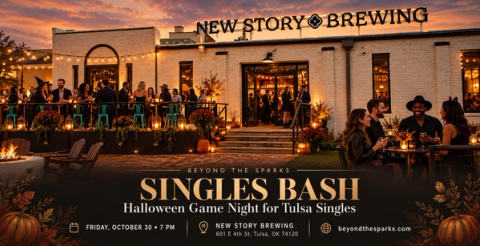
Next event · Singles Bash: Halloween Game Night for Tulsa Singles · Friday, October 30 · Tulsa · from $25.00 Reserve →
Start Your Free SPARK Quiz →