Every night we run an event at Cabin Boys Brewpub, we watch the same thing happen. Two strangers sit down across a small table in the back of a brewpub on North Main Street, and within a few minutes one of them laughs in a way that surprises them both. That is usually the moment. Not the first hello, and not the matched scorecard from the SPARK Quiz. The laugh.
We want to tell you about three of those moments. These are real Beyond The Sparks couples from Tulsa, and we have their permission to share what happened. Names and small details have been changed because they asked us to keep their lives private, but every story below actually happened in our room.
We are also going to walk through why these particular matches stuck, because the research on early attraction has gotten very good in the last few years, and it lines up neatly with what we keep seeing at our events.
Why Pre-Matching Changes the First Five Minutes
Most first dates spend their opening half-hour on background. Where did you grow up. What do you do for work. Do you want kids. People shuffle through these questions because they have to, but the questions themselves are not the date. They are the audition for the date.
A 2022 PNAS study by Eastwick and colleagues looked at more than 6,600 real speed dates and tried to figure out what predicted later romantic interest. The thing that mattered most was not raw attractiveness and not personality on paper. It was the unique fit between two specific people, what the researchers called relationship effects [1]. You either click with that one person or you do not, and you tend to know early.
That is the opening our SPARK Quiz tries to buy you. When a Tulsa single fills out the five-minute questionnaire and we pair them with someone whose answers actually align, the audition part of the date is mostly already over. You get to skip ahead to the part where you find out if you click.
You still have to click. We cannot fake that.
But you start the conversation already knowing the other person wants similar things on a similar timeline, and so the first five minutes can be about anything you want. They can be about the beer list. Or their drive over. Or the weird painting on the wall near the bathroom.
Story 1, The SPARK That Surprised Both of Them
J. and T. came to their first Beyond The Sparks event in February 2026 expecting to feel awkward. J. had been on Hinge for eighteen months and was tired in the way that long-time app users get tired. T. had cycled through three different apps and deleted all of them. Neither of them thought of themselves as event people.
They got matched on all five SPARK dimensions, which almost never happens. Most of our pairs share three or four. Five is rare enough that we noticed it when we ran the matching.
When they sat down, J. told us later, it felt like meeting someone she had been trying to describe but had never found words for. T. just said the conversation never had a flat spot.
They have been together since March 2026. Their first date was at Cabin Boys, and they kept going back, so now it is their place. They sit at the bar most Fridays.
Here is what we think happened with J. and T. The research on adult attachment, which goes back to Hazan and Shaver in 1987, says that securely attached partners tend to recognize each other quickly and feel safe almost immediately [2]. The SPARK Quiz does not measure attachment style directly, but several of our dimensions correlate with how people handle closeness, conflict, and independence. When two people line up on all five, what they are really lining up on is a shared sense of how a relationship should feel day to day.
That recognition is fast. It is also durable, which is why three months in, J. and T. were still calling Cabin Boys their place rather than burning out the way app couples often do around the same point.
Story 2, The Third Event Was the One
R. came to our February event. He came to our March event. He did not meet anyone either night that he wanted to see again, and he almost did not come back for the third one.
He did come back. At that third event he met K., who was attending Beyond The Sparks for the first time after years of using only apps.
Their SPARK Quiz answers overlapped strongly on Partnership Values and Relationship Vision, which means they wanted the same things on similar timelines. R. told us afterward that they were comparing notes about Colorado within the first ten minutes, and by the end of the night they were half-planning a trip. They are now actually taking it.
"On apps, you spend the first three months figuring out if you want the same things," R. said. "We knew that before we even sat down."
That sentence is the entire argument for pre-matching in one quote, so we want to sit with it for a second.
App dating front-loads attraction and back-loads compatibility. You match on a photo, you message for a week, you meet for a drink, and then somewhere around month two or three you find out one of you wants to move to Denver and the other one wants to stay in Tulsa near family. The conversation about values is the last one you have, not the first.
Speed dating with a compatibility layer reverses that order. You walk into a date already aligned on the big stuff, and you spend your time figuring out the only thing that actually matters at that point, which is whether you like each other. McKinsey research on how couples meet has found that in-person introductions produce relationships with about 28% higher satisfaction than app-based ones [3], and we suspect part of that is just the ordering. When you know the deal-breakers are off the table, you relax. You become more yourself. You become easier to like.
R. also told us something we hear a lot, which is that he almost did not come back. The Tulsa singles scene is small enough that a lot of people decide after one bad night that the whole format is not for them. We get it. But the data on speed dating is that it works for about four to six in ten attendees per night [4], which means there is usually a second or third event in the story before the one that sticks.
Show up again. It is worth it.
Story 3, The Slow Burn at the Bar
Not every Beyond The Sparks connection happens during the matched portion of the night, and we love that.
D. and A. were both still at Cabin Boys after our event ended. D. was getting a second beer at the bar. A. was finishing a conversation with a friend who was about to head home. They had not been matched with each other during the structured part, and they had not been introduced. They just ended up standing near each other and started talking.
Both of them had taken the SPARK Quiz. Both of them had met their official matches earlier that evening. The connection that actually stuck was the one that happened after the structure ended, in the loose post-event window where Cabin Boys does what it does best.
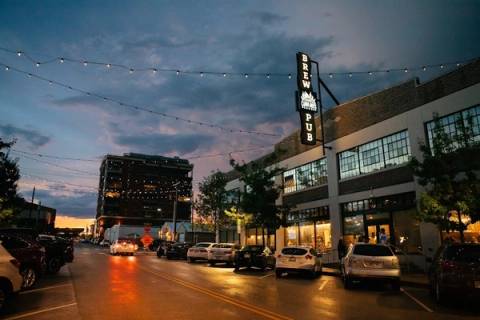
If you have not been there, Cabin Boys Brewpub is at 223 N Main St in the Tulsa Arts District. The space has a fireplace, thirty taps, a string-lit patio out back, and an easy after-work crowd most nights of the week [5]. It is one of the few spots in downtown Tulsa where a stranger striking up a conversation with you feels normal instead of weird.
We picked the venue partly for that reason. The matching is the structured layer of the night, but the venue is the unstructured layer, and the unstructured layer matters too.
D. and A. have been dating since. "The event gave us both a reason to be in the same room," A. told us. "Cabin Boys did the rest."
What These Three Stories Actually Show
Three stories is not a clinical sample, and we are not going to pretend it is. But the three couples we just walked through hit on three different patterns we see at almost every event, and the science backs up each one.
J. and T. are the high-overlap pattern. When two people share most of their SPARK dimensions, the recognition is fast, the early conversation feels easy, and the relationship tends to settle in quickly. That is consistent with the PNAS finding about relationship-specific fit being the strongest predictor of later interest [1], and consistent with the attachment literature about secure pairings feeling safe early [2].
R. and K. are the values-aligned pattern. They did not match on every dimension, but they matched hard on the ones about what a relationship is for and where it is going. That is the part app dating gets to last, and pre-matching gets to first. The result tends to look like accelerated closeness without the usual whiplash of finding out months in that you wanted different lives.
D. and A. are the venue pattern. They are also a reminder that we are not the only thing happening at our events. Cabin Boys is a real place with real regulars, and sometimes the right person is two stools down at the bar after the formal speed dating ends. We built the night to make that possible too.
If there is one thing we want you to take from all three of these, it is that real connection is still the hard part. We cannot manufacture a click. What we can do is shorten the runway, put you in front of someone whose answers actually line up with yours, and pick a room where conversation feels natural. The rest is up to you and them.
Where the Stories Tend to Come From
A few patterns we keep noticing across all the Beyond The Sparks couples we have followed up with.
Most of them did not match on the first try. The two who did, like J. and T., are the exception. More common is the R. and K. arc, where someone came once or twice without finding a stuck-the-landing match and then came back.
Most of them say the in-person speed dating format felt easier than they expected. People who arrive nervous tend to relax within the first round once they realize the time pressure actually helps, because if a conversation is flat you know it will be over in a few minutes. There is no obligation to fake an hour of small talk with someone you would not text the next day.
Most of them mention Cabin Boys by name when they tell the story. That is not because we asked them to. It is because the venue becomes part of the memory. The fireplace, the patio, the specific Friday night they walked in. You cannot get that from an app.
We are going to keep telling these stories as long as Tulsa keeps making them. If you want to be in the next round of them, the SPARK Quiz takes about five minutes, and the next event is on the calendar.
Sources
1. Baxter, A., Maxwell, J. A., Bales, K. L., Finkel, E. J., Impett, E. A., & Eastwick, P. W. (2022). Initial impressions of compatibility and mate value predict later dating and romantic interest. *PNAS*. https://www.pnas.org/doi/abs/10.1073/pnas.2206925119
2. Hazan, C., & Shaver, P. (1987). Romantic love conceptualized as an attachment process. *Journal of Personality and Social Psychology*, 52(3), 511-524. https://pubmed.ncbi.nlm.nih.gov/3572722/
3. McKinsey analysis cited in dating outcomes research summarized at https://www.datingadvice.com/studies/online-dating-success-rate-statistics
4. Speed dating match-rate aggregate data summarized at https://srsvp.com/does-speed-dating-work/
5. Cabin Boys Brewpub venue details, Tulsa Arts District. https://thetulsaartsdistrict.org/venue/cabin-boys-brewpub/
Frequently Asked Questions
Not necessarily — every guest leaves with at least one match from their first event. But as Story 2 shows, sometimes the right connection happens on the third visit. The Tulsa singles community that attends Beyond The Sparks events is warm and growing, and familiarity helps.
Absolutely — and they do, regularly. The facilitated matches are where we focus, but the Cabin Boys environment encourages real conversation for the full evening. Some of our best stories come from the post-event bar time.
Ready to Find Your Match in Tulsa?
Take the free SPARK Quiz and join us at our next event. Everyone leaves with at least one match.
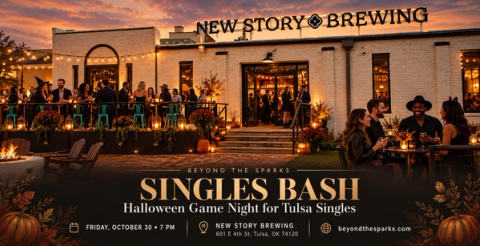
Next event · Singles Bash: Halloween Game Night for Tulsa Singles · Friday, October 30 · Tulsa · from $25.00 Reserve →
Start Your Free SPARK Quiz →