We want to tell you the honest version of how this started. Not the polished pitch. The real one. Because if you are single in Tulsa and reading this, you already know the problem we are trying to fix.
It was the summer of 2025. We had spent a lot of time watching how people meet in this city, or fail to meet. The pattern was hard to miss. Smart, kind, genuinely good people, doing everything the apps told them to do, going on dates that went nowhere, and quietly deciding that something must be wrong with them or wrong with Tulsa.
Neither was true.
The method was broken. And once we said that out loud, we could not stop seeing it everywhere.
The Numbers Backed Up What We Were Seeing
We started reading the research after we got tired of trading the same stories with friends. The numbers were worse than we expected. A 2024 Forbes Health survey of 1,000 dating-app users found that 78% feel fatigued with the apps sometimes, often, or always [1]. Among Millennials and Gen Z, the number climbed to 79%. Women reported even higher burnout at 80% [1].
The top reason people gave was simple. Forty percent said they could not find a real connection on the apps no matter how long they swiped [1]. That matched what our friends kept telling us. They were not lazy. They were not picky. They were exhausted.
And they were not alone. In the UK, roughly 1.4 million people quit dating apps between 2023 and 2024, and the trend kept accelerating into 2025 [2]. Industry watchers started calling it the Great Deceleration. People wanted something slower, smaller, and more real.
That word kept coming up everywhere we looked. Real.
Why Apps Will Never Solve This
Apps optimize for one thing, and that thing is engagement. They need you to keep opening the app. So they show you an endless feed of people. Not the right people. Just enough people to keep you scrolling another five minutes before bed.
The business model depends on you not finding a match quickly. Once you pair off, you delete the app and stop paying. So the incentives quietly work against you the whole time you are using the product.
In a mid-size city like Tulsa, this gets brutal fast. The dating pool is real but it is not endless. The same profiles cycle through week after week. You have seen everyone within ten miles. You have matched with half of them. Two-thirds of those matches never made it to a real conversation.
And when you do finally get to a first date, you discover in person what a profile could never tell you. Whether the energy is right. Whether the timing is right. Whether this person actually wants what you want. That is three to six weeks of texting just to learn something you could know in twenty minutes of face-to-face talking.
The math does not work. It never did.
And the second-order effects are even worse. Every disappointing date trains you to expect disappointment. Every ghosted match trains you to ghost back. Every profile that looked great on the screen and felt flat in person teaches you to distrust your own judgment. After a year or two of that, a lot of people just quit. Not because they stopped wanting love, but because the search itself started feeling like a part-time job they were losing money on.
We watched friends go through this. We watched siblings go through this. We went through pieces of it ourselves. And the more we talked to other singles in Tulsa, the more obvious it became that the city was full of people who had given up on the apps but had nowhere else to go.
That gap was the opening.
What the Research Actually Says About Compatibility
So we went and read the studies. The one that hit us hardest was a 2022 paper in the Proceedings of the National Academy of Sciences by Baxter, Maxwell, Bales, Finkel, Impett, and Eastwick [3]. The team meta-analyzed three speed-dating studies with longitudinal follow-ups across 559 participants.
What they found changed how we thought about everything. Compatibility, meaning the unique spark between two specific people, predicted later romantic interest and actual dating behavior. Not generic attractiveness. Not how picky someone was. The thing that mattered was whether two people clicked with each other, specifically, in person, in real time [3].
You cannot fake that in a profile. You cannot algorithm your way to it. You have to be in the room.
But here is the part that gave us hope. The same research showed that initial impressions formed in short face-to-face meetings carried real predictive weight months later [3]. Twenty minutes of real conversation tells you more than two months of texting. That is not romantic mythology. That is peer-reviewed science.
So the question became simple for us. How do you get the right people into the same room at the same time, and then give them the structure to actually meet each other?
How the SPARK Quiz Came Together
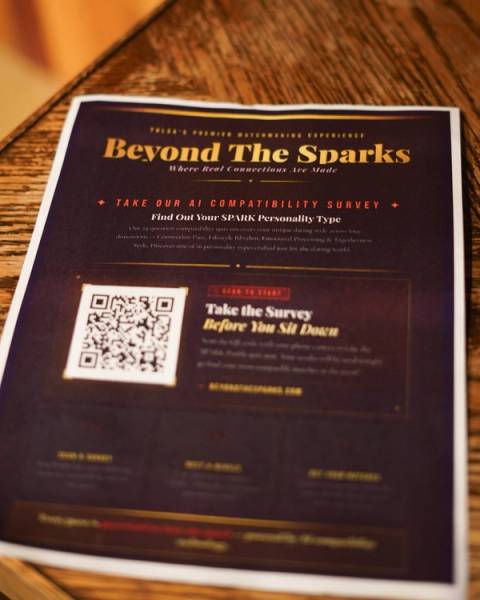
That question became the SPARK Quiz. Five minutes. Five dimensions that research consistently links to relationship success.
Social energy. How you recharge, how you show up at a party, whether you want to talk for three hours or wave from across the room and go home.
Partnership values. What you actually want a relationship to be built around. Family. Adventure. Stability. Faith. Growth.
Attachment patterns. The way you bond, the way you handle stress, the way you ask for what you need. Attachment style research has shown for decades that secure pairings predict happier long-term relationships, and that mismatched styles cause most of the recurring fights people think are about laundry.
Relationship vision. Where you want your life to go in the next two, five, ten years. Kids or no kids. City or country. Career-first or family-first.
Love language. How you give and receive care.
Five things that photos cannot tell you. Five things proximity cannot predict. Five things you would normally have to spend months figuring out across awkward coffee dates and avoided texts.
We collapsed all of it into five minutes so you can take it on your phone in line at the grocery store. And then we use your answers to pre-match you with people whose answers actually fit yours, before you ever walk into the room.
That is the whole idea. We are not trying to replace chemistry. We are trying to make sure the room is full of people you might actually have chemistry with.
Why We Went With In-Person Events Instead of Another App
Once we knew the science, the format was obvious. We were not going to build app number 4,000. The world did not need that and neither did Tulsa.
We were going to build live events. Real rooms. Real conversations. Real eye contact.
The intentional dating trend backed this up too. Hinge reported a 39% revenue jump in 2024, far ahead of their parent company, mostly because they leaned into Gen Z users who want slow, deliberate dating [4]. Tawkify and other matchmaking services saw similar surges as app-fatigued singles looked for something with a human touch [2]. Across the board, people were voting with their wallets for in-person, intentional, and small-batch.
We agreed with the trend. We also wanted to push it further. A matchmaking service still gatekeeps the experience. A speed dating event lets you meet eight or ten compatible people in one night and decide for yourself.
So that is what we built.
Why Cabin Boys Brewpub
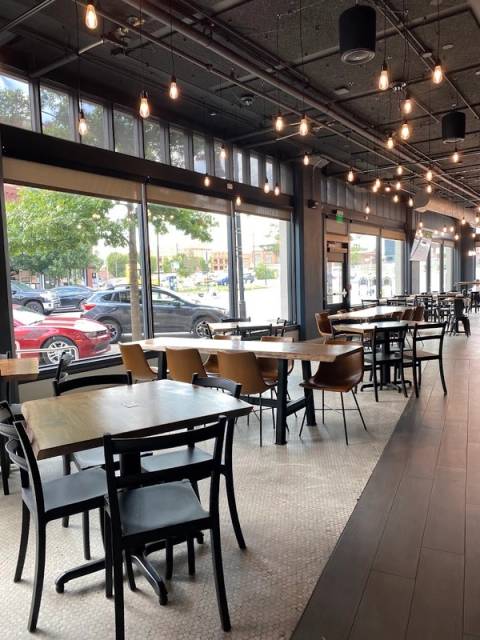
We spent a few months thinking about venue before we committed. A great venue for a dating event has to do a few specific things well. It has to feel warm and real, not corporate and not transactional. It has to be comfortable enough that people can stay for three hours and not feel like they are overstaying. And it has to support conversation instead of competing with it.
The sociologist Ray Oldenburg called places like this third places [5]. Not home. Not work. A neutral spot where regulars show up, strangers become friends, and conversation is the main event. Oldenburg listed eight things that make a third place work, and craft brewpubs hit almost all of them when they are run well [5]. Neutral ground. Conversation as the centerpiece. A playful mood. A home away from home feeling.
Cabin Boys at 223 N Main St in the Tulsa Arts District does all of that and then some. The taproom feels like a living room with great beer. The staff knows regulars by name. The space was designed for people to linger and talk, not to shout over a DJ. It sits in walking distance of half the best food and music in downtown, so the night does not have to end when the event does.
It felt like the right room. We knew it the first time we walked in.
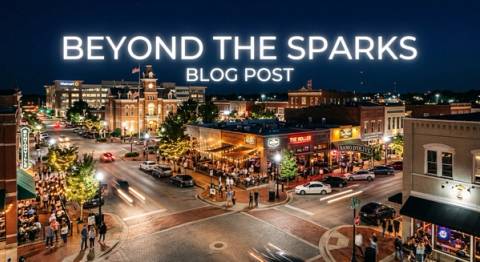
There is one more reason the venue mattered to us. The Tulsa Arts District has been quietly building itself into something special over the last decade. Guthrie Green sits two blocks away. The Woody Guthrie Center and the Bob Dylan Center are around the corner. First Friday Art Crawl rolls through every month and turns Main Street into a moving party. When the event ends at Cabin Boys, the night does not have to end. You can keep talking over coffee, walk to a show, or grab dinner without ever getting back in your car. That is the kind of neighborhood that turns a single match into a second date and a second date into a third.
A great venue is not just the building. It is everything within walking distance of the door. We picked Cabin Boys because it sits in the middle of the best small-radius dating neighborhood Tulsa has ever had.
What We Are Building For
We are not trying to replace falling in love. We could not if we wanted to. What we are trying to do is fix the part right before that, the part where two compatible people in the same city of 400,000 never actually meet each other because the algorithm did not bring them together.
We want you to walk in on a Friday night, hand your phone over for two hours, talk to eight people who already passed a compatibility filter, and walk out with at least one match you are genuinely excited to see again. No swiping. No ghosting. No three-week text marathons that end in disappointment.
Just the room, the people, and the rest of your story.
What Is Coming Next
As of mid-2026 we are running events at Cabin Boys regularly and the early matching results have been better than we hoped. The format works. The science holds up in real life. And the Tulsa singles who keep showing up keep telling us this is the version of dating they actually wanted all along.
If you are tired of the apps and you live anywhere near the Arts District, we want you in the room when we open the doors again. Take the free SPARK Quiz at beyondthesparks.com. That is step one. We handle the rest.
We will see you at Cabin Boys.
One last thing. We built this for Tulsa first because Tulsa is where we live and where we want to see something real take root. The people here deserve a better way to meet, and we think you are going to be surprised by how good the room feels when the right people are in it.
Sources
[1] Forbes Health, Dating App Burnout Survey 2024 https://www.forbes.com/health/dating/dating-app-burnout/ [2] befriend.cc, The Great Deceleration https://befriend.cc/2025/12/29/great-deceleration-dating-apps-losing-trust/ [3] Baxter et al., Initial impressions of compatibility and mate value predict later dating and romantic interest, PNAS 2022 https://www.pnas.org/doi/10.1073/pnas.2206925119 [4] Global Dating Insights, Hinge Leans Into Gen Z Dating Trends Amid Industry Fatigue https://www.globaldatinginsights.com/featured/hinge-leans-into-gen-z-dating-trends-amid-industry-fatigue/ [5] The Beer Professor, Craft Breweries As Third Places https://www.thebeerprofessor.com/?p=4408
Frequently Asked Questions
We're targeting early 2026 for our first live events at Cabin Boys Brewpub in Tulsa. Sign up for the waitlist and take the free SPARK Profile at beyondthesparks.com to be first on the guest list when we open registration.
Most personality tests tell you about yourself. The SPARK Profile is specifically designed to predict relationship compatibility — it measures the five dimensions that research links most directly to whether two people can build something lasting together.
Yes — the SPARK Profile quiz is completely free at beyondthesparks.com, and always will be.
Ready to Find Your Match in Tulsa?
Take the free SPARK Quiz and join us at our next event. Everyone leaves with at least one match.
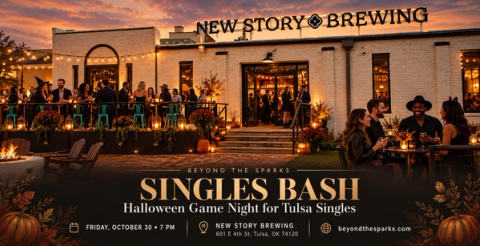
Next event · Singles Bash: Halloween Game Night for Tulsa Singles · Friday, October 30 · Tulsa · from $25.00 Reserve →
Start Your Free SPARK Quiz →