Dating after 33 rewards clarity and punishes ambiguity. That's easier to say than to act on, so here's what it actually looks like in practice — twelve specific behaviors, grounded in what recent research and real women's own accounts say about what works, not what sounds good in a caption.
Say what you want. Actually say it.
The clearest shift researchers and daters both point to is specificity. Women interviewed for a 2025 VICE feature on how dating standards change in the 30s described getting 'clearer about goals' and screening harder instead of wider [1]. That's the opposite of the instinct to soften your intent so you seem more open — a bio or a first conversation that states what you actually want filters out mismatches faster than a vague one ever will. It also means retiring the apology. 'I'm too picky' is usually just 'I know what I want,' said by someone who didn't meet the bar and would rather you lower it than raise theirs.
Use more than one channel, and judge by pattern, not a single date
Relying on one app is relying on one algorithm, and that algorithm isn't neutral. Researchers at the Universitat Oberta de Catalunya found dating apps favor users between 20 and 30 and reduce visibility for almost everyone older [2] — an argument for treating apps as one channel among several, not the whole strategy. Events, classes, and introductions through people who already know you fill in exactly the gap the algorithm creates.
Once you're actually meeting people, resist judging from a single data point. Match and the Kinsey Institute's 2025 Singles in America study found most people can't reliably tell whether chemistry is real until the third date [3] — which cuts both ways. Don't write someone off after one flat evening, and don't assume one great date means more than it does. Pattern beats moment, consistently.
Ask the real questions early, and don't let one bad answer become a permanent filter
Timeline, kids, values, what a serious relationship actually means to someone — asking early feels forward and saves months. It's a cheap question compared to the alternative. What's more expensive is the opposite habit: letting one bad relationship write a permanent rule for every one after it. Blanket-banning a 'type' after a bad experience doesn't protect you from the next bad match; it just removes good matches along with it, because the actual problem was rarely the category, it was the person.
Trust what people do, not what they say, and don't let dating take over your life
Whether someone follows through on small stated things predicts more than any amount of charm on a first date. It's also unglamorous advice, which is probably why it gets repeated less than 'find your person.' Keep a life that exists independently of dating — friends, work, things you'd be doing whether or not you were seeing anyone. Women in the VICE feature described choosing partners who'd 'positively affect' a life that was already full, not partners meant to complete an empty one [1]. That distinction shows up in how a person dates: desperation is legible, even in a text response time, and it tends to attract exactly the kind of attention you don't want.
Don't run your current dating life on your 20s dating rules
The dating landscape has also just changed. A February 2026 survey of over 5,000 unmarried adults found only 26 percent of women were dating even once a month, and the top obstacles were money, confidence, and past bad experiences, not a lack of trying [4]. If dating now takes more deliberate effort than it did a decade ago, that's a real shift in the landscape, not a personal failure. Comparing your current pace to your 20s dating self is comparing two different environments, not two versions of your effort.
The Bottom Line
None of the twelve behaviors above require doing more. Most of them require doing less of what doesn't work — vague intentions, one-date verdicts, blanket rules from old relationships, and comparisons to a decade that ran on different rules — and more of the few things that consistently do: say what you want, watch for patterns, and let the wrong matches filter themselves out quickly.
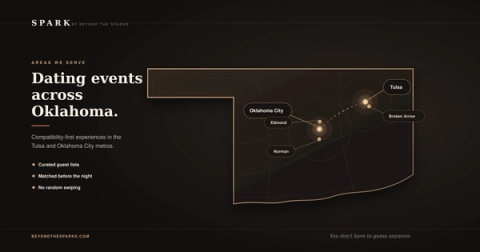
If you'd rather start from a room already filtered for compatibility, Beyond The Sparks runs speed dating and matchmaking events in Tulsa, Oklahoma built around exactly that — the SPARK Quiz does the early filtering before you ever sit down across from someone.
Sources
1. Caramela, Sammi. "7 Ways Women Say Their Dating Standards Changed in Their 30s." VICE, August 3, 2025. https://www.vice.com/en/article/7-ways-women-say-their-dating-standards-changed-in-their-30s/
2. Linares-Lanzman, J., Rosales, A., et al., Universitat Oberta de Catalunya, "Digital ageism on dating apps: discrimination affects people aged 30 onward," 2024. https://www.uoc.edu/en/news/2024/digital-ageism-on-dating-apps
3. Match and The Kinsey Institute, 14th Annual Singles in America Study, June 2025. https://match.mediaroom.com/2025-06-10-Match-and-The-Kinsey-Institute-Unveil-14th-Annual-Singles-in-America-Study
4. Institute for Family Studies & Wheatley Institute, "State of Our Unions 2026: The Dating Recession," February 2026. https://ifstudies.org/report-brief/state-of-our-unions-2026-the-dating-recession
Dating After 33 FAQs
Ready to Find Your Match in Tulsa?
Take the free SPARK Quiz and join us at our next event. Everyone leaves with at least one match.
Next event · Dallas SINGLES MIXER (Slow Dating > Speed Dating) · Saturday, September 19 · 2965 S. Hwy 161, Grand Prairie, TX 75052 (Located in the EpicCentral entertainment district) · from $35.00 Reserve →
Start Your Free SPARK Quiz →