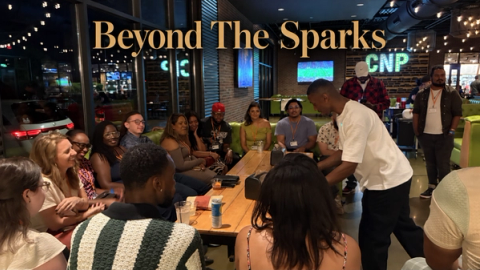
The bar at a Beyond The Sparks event is loud enough that you can't quite hear the band, which is on purpose, because it forces people to stand closer to talk. Across the room, someone catches your eye for a half second longer than a stranger normally would. You look away. You look back. They're still there, angled slightly toward the room instead of away from it.
Most people read that moment as luck. It isn't. It's one of dozens of catalogued nonverbal signals that researchers have been quietly studying since the 1980s, and most of what actually predicts whether an approach works has almost nothing to do with what either person says.
We've already written about why pickup lines don't work. This isn't that post. This is about what happens before anyone opens their mouth, and it turns out the research on that part is both more specific and more useful than almost anything in the "flirting tips" genre.
The 52 Signals Nobody Notices They're Using
In the mid-1980s, researcher Monica Moore ran one of the more unusual studies in social psychology. She had trained observers quietly watch women in bars, on a college campus, and in other public settings, recording every nonverbal behavior they could categorize. What she found was a catalog of 52 distinct signaling behaviors, grouped into facial and head movements, gestures, and posture shifts [1].
Some of these are things you'd expect: a glance held a beat too long, a head tilt, a smile that lingers. Others are subtler. A brief, darting sideways glance that lasts under three seconds, repeated two or three times in quick succession, turned out to be one of the more reliable signals in her data, distinct from a longer, fixed gaze that reads differently and tends to come later in an interaction, once interest has already been established.
Signaling, not looks, moved the needle on who got approached and who didn't.
The part of Moore's research that matters most for anyone trying to understand flirting isn't the catalog itself. It's what the signaling predicted. Women who displayed more of these behaviors were approached more often, and follow-up work built on her findings suggested that the frequency of signaling was a better predictor of being approached than physical attractiveness was.
That's worth sitting with. The common assumption is that attraction is primarily visual and passive, you either have "it" or you don't, and the room responds accordingly. The research says something closer to the opposite. Visibility of interest, the active, repeated signaling of it, outperformed static attractiveness as a predictor of approach. That's a mechanism you can actually practice, which "be more attractive" never was.
The Five Flirting Styles, and Why They Don't Perform Equally
A separate and more recent line of research gives us a second, complementary piece of the picture. In 2010, a team of researchers led by Jeffrey Hall surveyed thousands of adults and used statistical factor analysis to identify five distinct styles people use to communicate romantic interest: physical, traditional, polite, sincere, and playful [2].
Physical style leans on communicating interest through touch and physical proximity. Traditional style leans on letting the other person, typically framed as the man, take the lead while playing a more passive role. Polite style relies on good manners and a cautious, low-risk way of signaling interest. Sincere style is built around direct, authentic expression of genuine interest. Playful style uses humor and teasing as the primary vehicle for flirting.
Here's the part that actually matters if you're trying to get better results instead of just understanding the taxonomy: these styles are not equally effective. The research associated physical, sincere, and playful styles with greater dating success. Traditional and polite styles, the two built around passivity and caution, were linked to less success. In other words, the two "safest," lowest-risk styles of flirting were also the two that performed the worst.
That's a genuinely uncomfortable finding for anyone whose instinct is to flirt carefully. Caution feels like the responsible choice. The data suggests it's also often the losing one.
Why Men and Women Often Get Different Results From the Same Tactic
This is where most "flirting tips" content falls apart, because it treats flirting as one unified skill that works the same way regardless of who's doing it. The research doesn't support that. Hall's study found that women scored higher than men on every style except playful, meaning women reported using most of these tactics more frequently across the board. That asymmetry matters because it changes what "improvement" looks like depending on which side of the interaction you're on.
For a lot of men, the practical gap isn't knowing how to flirt once they've decided to approach. It's correctly reading the signaling that's already happening before they approach, the kind Moore catalogued decades earlier. A man waiting for an unmistakable, deliberate invitation is often missing a string of smaller, repeated signals that were never going to escalate into anything more obvious, because escalating further is typically not how that signaling works. The data on approach rates suggests that acting on moderate, repeated signals rather than waiting for certainty tends to outperform both the man who never approaches and the man who approaches without any signal at all.
For a lot of women, the gap runs the other direction. The traditional and polite styles, the ones most culturally coded as "appropriate" or "ladylike," are statistically the two associated with the least dating success. Sincere and playful styles, more direct expressions of actual interest, performed better. That's a hard thing to act on in a culture that still rewards women more for restraint than for directness in a lot of social contexts, but the data is fairly consistent on which approach actually gets results.
What This Looks Like in Practice
If you're a man at an event and you notice someone glancing over more than once, the data suggests the move is to approach on a moderate, repeated signal rather than waiting for a signal so obvious it removes all doubt. That certainty rarely arrives, and waiting for it means most real opportunities pass by unacted on.
If you're a woman and your instinct is to flirt through politeness, through being pleasant and agreeable and hoping that reads as interest, the research suggests that's statistically your weakest tool. A more direct comment, a genuine question asked with real curiosity, or actual playful teasing outperform the safer, more withheld version of the same interaction.
For both, the throughline is the same: active, visible signaling beats passive availability. Hoping to be noticed is a worse strategy than being noticeable, and being noticeable is a worse strategy than directly, if lightly, signaling interest.
Why This Matters More in a Room That's Already Filtered
Here's the part that connects back to why we built Beyond The Sparks the way we did. All of this research describes general-population dating environments, bars, campuses, apps, places where the person across the room might be a great match or might have nothing in common with you at all. In that context, caution has a real cost, because you're spending limited social risk on unknown odds.
A SPARK Quiz changes the odds before you ever signal anything. When the room has already been filtered across five real compatibility dimensions, the calculus shifts. The riskier, more effective styles, physical, sincere, playful, cost less to use, because the person you're signaling toward has a meaningfully better-than-random chance of being someone worth the directness. That's the actual argument for compatibility-first events: not that they make flirting unnecessary, but that they make the more effective, higher-signal version of flirting cheaper to attempt.
Two Myths This Research Quietly Kills
The first myth is that women can't or shouldn't be the one to signal first. Moore's catalog of 52 behaviors was built entirely from observing women initiating contact nonverbally before a man ever approached, and her later work found that it was the frequency of that initial signaling, not passivity, that predicted who got approached. The idea that women should simply look good and wait is not what the data describes happening in rooms where connections actually form.
The second myth is "playing hard to get" as a broadly winning strategy. It's a real tactic, and it shows up in some flirting research as a scarcity signal that can increase perceived value in specific contexts. But it's a narrow tool, not a general strategy, and it's easily confused with the traditional and polite styles that Hall's research found performed worst overall. Scarcity can work as an accent. It doesn't work as a whole approach, and most people who think they're "playing it cool" are really just defaulting to the passive style the data says underperforms.
Why Repetition Beats a Single Big Moment
One detail in Moore's original data is easy to skip past but genuinely useful: the darting glance she catalogued tends to occur in bouts of three, spaced out rather than delivered all at once. Signaling interest isn't usually a single dramatic moment. It's a short, repeated pattern over the course of several minutes, which means a single unanswered glance or unreciprocated comment is not useful information about whether interest exists. It's one data point in a pattern that either continues or doesn't.
That matters practically because it argues against reading too much into any one moment, in either direction. A missed glance isn't rejection. A missed opener isn't a closed door. The research suggests the better move, for men and women both, is to treat early signals as the first of a short series rather than a single make-or-break test, and to keep the signaling consistent for a few minutes before concluding anything either way. Events that run for a couple of hours, rather than a five-minute speed-dating rotation, give that kind of repeated signaling room to actually happen.
What a Night at a Beyond The Sparks Event Looks Like Through This Lens
Walk into a Thursday night at one of our Tulsa events and you'll see both of these dynamics playing out constantly, just with better odds attached. Because every guest has already taken the SPARK Quiz before arriving, the room is pre-filtered across five compatibility dimensions, which means the "is this worth the risk" calculation that normally makes people default to polite, low-signal behavior gets a lot less expensive to answer. People signal more, and more directly, because the downside of a miss is lower when the room's already been narrowed to people with a real shot at compatibility.
That's a small environmental change with an outsized effect. The research says physical, sincere, and playful styles win. Those are also the styles that require the most trust that the risk is worth it. Lower the cost of being wrong, and more people default to the styles that actually work, instead of the ones that just feel safer.
The So What
The data is consistent on one point across two completely separate decades of research: the safest-feeling tactics, waiting, staying polite, hoping to be noticed, are statistically the weakest ones. Visible, repeated, moderately direct signaling outperforms caution almost every time it's been measured.
Take the SPARK Quiz. We'll see you there, where the room's already filtered, so the risk of being direct is lower than it feels.
Sources
1. Moore, M. M. (1985). Nonverbal courtship patterns in women: Context and consequences. Ethology and Sociobiology, 6(4), 237-247.
2. Hall, J. A., Carter, S., Cody, M. J., & Albright, J. M. (2010). Individual differences in the communication of romantic interest: Development of the flirting styles inventory. Communication Quarterly, 58(4), 365-393.
Frequently Asked Questions
According to the research on flirting signals, yes. Moderate, repeated signaling is common and rarely escalates into something unmistakable, so waiting for certainty means missing most real opportunities.
Research using the Flirting Styles Inventory found women report using most flirting styles more often than men, except for playful style, and that the styles associated with real dating success (physical, sincere, playful) differ from the ones culturally coded as safe (traditional, polite).
The research says yes. Physical, sincere, and playful styles were linked to greater dating success, while traditional and polite styles were linked to less.
Ready to Find Your Match in Tulsa?
Take the free SPARK Quiz and join us at our next event. Everyone leaves with at least one match.
Next event · Singles Event: Halloween Game Night Bash for Tulsa Singles October 30th · Friday, October 30 · Tulsa · from $25.00 Reserve →
Start Your Free SPARK Quiz →