You are 32. You opened Hinge last night and the photos blurred into each other. You closed it before you finished the queue. Then you stood in your kitchen for a minute trying to decide if that was a problem or a sign of growth.
It is both. Dating in your 30s is not just dating in your 20s with more money and worse knees. The whole shape is different. The stakes are different. The options look different. The criteria are sharper. And almost nobody warns you that the strategy that worked in your 20s will actively hurt you now.
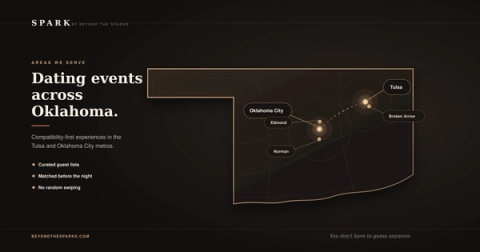
We run Beyond The Sparks, a compatibility-matched dating events company in Tulsa, with our first OKC event landing June 27 at Chicken N Pickle. The 30s crowd is our biggest audience. So we have spent a lot of time understanding what actually changes between decades, and what the 30s dater needs to stop doing.
What actually changes when you turn 30
Six things shift. Not all at once. But all six are noticeable within the first two years of your 30s, and they compound across the decade.
- Stakes go up. In your 20s, a six-month relationship felt long. In your 30s, it feels like a budget item. Time has weight you did not feel before.
- Energy goes down. Not in a bad way. You just stop being willing to spend six hours in a loud bar hoping. The math on "is this worth a Friday" gets honest.
- Criteria sharpen. You know what you do not want now. You spent a decade learning. The list of dealbreakers is shorter but harder.
- Options narrow on the surface and widen underneath. Your single peer group shrinks because half of them paired off. But the remaining single people are clearer about what they want, so the conversion is higher.
- Pace changes. You date slower. Three weeks of texting becomes a red flag, not a courtship. You want to meet faster and know faster.
- Your own story becomes data. The patterns you fell into in your 20s are now visible. You can name them. You can choose not to repeat them. Sometimes you repeat them anyway.
What stays the same
The loneliness is the same. Anyone selling you "I just love being single in my 30s" content is performing. Being single in your 30s is fine. It is also lonely sometimes. Both are true.
The apps still dominate the time spent. People in their 30s still default to Hinge and Bumble because that is where the supply is. The supply is fine. The conversion to in-person is bad. We wrote more about that pattern from the Tulsa side and the same logic applies in OKC.
And the basic dimensions of compatibility do not change with age. Communication style, lifestyle alignment, emotional patterns, values, and closeness preferences. These are what predict chemistry in your 20s and in your 30s and in your 60s. The dimensions are constant. Only your tolerance for mismatch on them changes.
Early 30s vs mid 30s vs late 30s
The decade is not one thing. The early, middle, and late 30s play very differently, and the strategy that worked at 31 will not work at 38.
Early 30s, roughly 30 to 33, are the testing years. You still feel like you have time. You can date someone for nine months, realize it was not it, and not feel the math compress. The criteria are sharper than 28 but not yet final. This is where most 30-somethings still use a slightly slowed 20s playbook. It mostly works.
Mid 30s, 34 to 36, are the urgency window. The kids-or-not question gets concrete. Your peer group is fully paired off and the social calendar shifts toward couples-dinner energy. The mistake here is panicking and lowering your bar. The opposite mistake is being so afraid of the panic-version that you reject perfectly good people for cosmetic reasons. Hold the bar where it was at 32. Move faster.
Late 30s, 37 to 39, are the patience window. By now the urgency has either gotten you somewhere or it has not. People who pushed too hard in the mid 30s often spent two years repairing the rebound. The late-30s mood, in our event guest lists, is more honest and less performative than any other age cohort. People know what they want. They do not pretend they do not.
What 30s daters actually want
A pattern shows up in our event guest lists. People in their 30s say two things almost universally. They want a partner who has done their own work. And they want to skip the part where you spend three months figuring out if you are dating or just hanging out.
"Has done their own work" is shorthand for emotional regulation, conflict tolerance, and self-awareness. Therapy is not required but it helps. A history of long-ish relationships also helps because it shows the person can sustain something. A pattern of three-month-and-disappear cycles is a 30s dealbreaker in a way it would not have been at 26.
"Skip the ambiguity phase" is shorthand for a directness 20-somethings often cannot do without panic. Asking "are we dating" at week three in your 30s is healthy. Asking it in your 20s often felt like accelerating a thing that was supposed to unfold slowly. The slow unfolding worked when you had a decade of unfolds left.
The mistake 30s daters make
They keep using the 20s playbook. They go to the bars. They wait three days to text. They stay in situationships out of nostalgia for what an undefined thing used to feel like. They treat their criteria as if they were still negotiable.
They also overcorrect. They lead first dates with checklists. "Are you sure you want kids in the next three years." "Do you have your finances in order." "Are you fully over your last relationship." None of these are bad questions. They are bad first questions. They signal you are running an audit, and the warm, smart 30-something across from you will close down.
The other 30s mistake is staying in apps too long. The apps are designed for the 20s discovery game. They are not designed for the 30s clarity game. By month four of pure-app dating in your 30s, you are usually tired and bitter and you have stopped giving people a real chance.
The mistake 20s daters who envy their 30s friends make
You think the 30s game is easier because the criteria are clearer. The criteria are clearer because they were earned. You have not earned yours yet. That is the whole job of your 20s. The criteria show up after the data shows up.
So borrowing the 30s clarity-first move in your 20s usually backfires. You over-filter on paper and miss the right person sitting two stools down at Cabin Boys because their bio said something you did not like.
Dating with kids (and dating people who have them)
A real share of 30s daters have kids. The apps do not handle this well. The category gets buried, the photos get awkward, and the bio space is too short for the real answer.
If you have kids, the question to lead with is not "are you ok with me having kids." It is the same compatibility question as anyone else, asked plainly. Your kids change the calendar, not the dimensions. A first date should still be about who you are, not who is at home on Tuesday nights.
If you are dating someone with kids, do not perform tolerance. Ask honestly what their week looks like, when they are available, and what they want this thing to be. Tulsa and OKC are small enough that schedules matter. A Cabin Boys patio night plus a sitter is real coordination, not a wing-it move. Respect the coordination and the rest gets easier.
Divorced and dating in your 30s
A meaningful share of 30s daters in Tulsa and OKC have been married. The first long-form relationship after a divorce has a different gravity than dating in your 20s ever did. You have already done the all-in thing once. You know what it is. So the bar for "is this it" is higher and the patience for ambiguity is lower.
The small-metro factor compounds this. Tulsa and OKC are both six degrees of separation, not six hundred. People may know your ex. You may know theirs. The honest move is to name it briefly, once, and then move past it. The dishonest move is to pretend the social context does not exist.
Dating in Tulsa or OKC in your 30s specifically
Smaller metros change the math. The single biggest change is that you will see them again. Tulsa's downtown dating scene is six neighborhoods you can walk between. OKC is denser than the population suggests because the central districts (Midtown, Plaza, Paseo, Uptown 23rd) are clustered in a tight walkable grid. So ending a relationship badly has actual social consequences. You will see them at the next First Friday or the next Cabin Boys patio Friday. This is not a downside. It just changes how you behave.
The 30s singles pool in Tulsa is smaller than in OKC by sheer population. But the conversion rate is higher because the apps are doing less work here. Tulsa singles in their 30s are showing up at things. Run clubs at Riverside Path. Pottery classes at Heller Theatre Workshop. Slow social formats where you see the same faces twice.
In OKC, the equivalents are the Scissortail Park Walking Club on Thursday and Sunday mornings, the OSSO Sports and Social leagues, and Chicken N Pickle in the north metro. The pattern is the same. Repeat exposure. Slow conversion. Higher quality.
What works for 30s dating
Use the apps as one channel, not your only channel. Pair them with one structural commitment per month. A class, a league, a recurring event. Pick something where you will see the same people three times. Repeat exposure does more work than any opening line.
Date faster, not slower. Move from app to phone to in-person in under two weeks. The 20s version of texting for a month before meeting is a 30s mistake. Anyone who needs a month of texting to commit to coffee is usually telling you something about how they handle commitment more broadly.
Ask compatibility-shaped questions early without auditing. The first date is not the time to ask about kids and money. It is the time to ask what their perfect Sunday looks like and what is the last thing that genuinely annoyed them. Those reveal what kids-and-money will eventually look like.
Rule out fast. The defining 30s dating skill is the ability to say "this is not it" after one date without spending a week on the post-mortem. Your time is the constraint now. Spend it on people who clear the bar quickly.
And rule in honestly. The opposite mistake of fast-ruling-out is fast-ruling-in. "She likes the same band, this must be it" produces three-month relationships that should have been three weeks. Compatibility is shape, not coincidence. The shape takes a few dates to read. Give it those dates.
The dating-fatigue trap
A pattern we see often. A 35-year-old who has been on Hinge for two years opens it once a week, swipes for ten minutes, closes it, and concludes "dating in OKC is dead." It is not. Their stamina is. There is a difference between the dating market being broken and your particular relationship to it being exhausted.
The remedy is not more app time. It is less, and replaced with one structural commitment. A pickleball ladder at the Greater OKC Pickleball Club. A run with the OKC Landrunners. A regular Cabin Boys patio night in Tulsa. Something where the dating goal sits in the background and the in-person, repeat-exposure social reps happen in the foreground. The math shifts within a month, sometimes within a week.
Where Beyond The Sparks fits
We are built for the 30s problem specifically. The model is small. You take a five-minute SPARK Quiz online, which scores you across the five dimensions that predict chemistry. We use the results to build event guest lists where every person already has at least one compatibility match in the room before doors open.
So you walk in already pre-mapped. You skip the dimension-auditing phase, which is the slowest part of 30s dating. You are talking to someone who actually fits how you connect, not someone you swiped on at 11 p.m. because the photos looked fine.
Tulsa runs monthly at Cabin Boys Brewpub. Our first OKC event lands June 27 at Chicken N Pickle, 8400 N Oklahoma Avenue. The events page has dates and tickets.
Frequently Asked Questions
Ready to Find Your Match in Tulsa?
Take the free SPARK Quiz and join us at our next event. Everyone leaves with at least one match.
Next event · Dallas SINGLES MIXER (Slow Dating > Speed Dating) · Saturday, September 19 · 2965 S. Hwy 161, Grand Prairie, TX 75052 (Located in the EpicCentral entertainment district) · from $35.00 Reserve →
Start Your Free SPARK Quiz →