
'Lower your standards.' 'The good ones are taken.' 'You waited too long.' All popular. All repeated constantly by people who mean well. None of them hold up against the actual research on dating after 33 — here's what recent studies say instead.
Myth: Lowering your standards gets you more, and better, matches
The opposite trend shows up in the data. Women interviewed for a 2025 VICE feature on dating in your 30s described the shift as getting 'clearer about goals' and screening harder, not wider — trading early chemistry for consistency, effort, and communication [1]. Vague standards don't produce better matches; they let more mismatches stay in the running longer, which is the opposite of the intended effect.
Myth: The good ones are already taken by 33
What the research actually shows is a visibility problem, not an availability one. Researchers at the Universitat Oberta de Catalunya found dating-app algorithms favor users between 20 and 30, then reduce visibility for almost everyone older [2] — meaning a 34-year-old's profile is shown to fewer people by design, regardless of how compatible that person is. A smaller number of profiles in your feed reflects how the app is built, not how many good people are out there.
The algorithm decides who gets seen. It doesn't decide who's actually available.
Myth: If it's not effortless anymore, you're with the wrong person
This is the myth the data corrects most directly. A meta-analysis spanning more than 165,000 participants found relationship satisfaction typically declines from age 20, bottoms out around 40, then rises again through 65 [3]. That pattern shows up broadly, not just in mismatched relationships. Reading a normal dip as proof you chose wrong is one of the more expensive misreadings the research warns against.
Myth: If you were meant to find someone, most women your age already have
A February 2026 survey of 5,275 unmarried adults found only 26 percent of women counted as active daters, and close to three-quarters of women who expect to marry someday had gone on few or no dates in the past year [4]. The 'everyone else already found someone' feeling is common. It's just not what the numbers show. Most peers are dating less than it seems from the outside, not more.
Myth: More volume, more swiping, more dates, is what gets results
Targeting beats volume in the data too. The 2025 Singles in America study found most people can't reliably judge chemistry until the third date [5], which argues against snap-judging a large volume of first dates and for paying real attention to fewer of them. Combined with the VICE finding that women who screened harder reported better outcomes than women who dated wider [1], the actual pattern favors fewer, more deliberate interactions over more, shallower ones.
The Bottom Line
Every myth above points the same direction: the fix was never 'try harder' at an approach that wasn't working. It's dropping assumptions the data doesn't support, and replacing volume and vague intentions with the two things that actually show up in the research: specificity and attention.
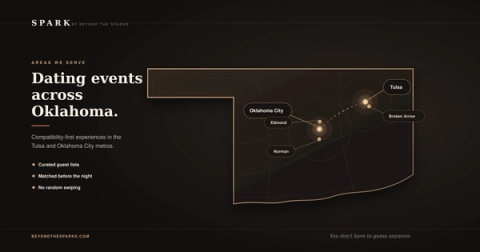
Beyond The Sparks builds exactly that kind of specificity and attention into events in Tulsa, Oklahoma — the SPARK Quiz matches guests on compatibility before a single introduction happens.
Sources
1. Caramela, Sammi. "7 Ways Women Say Their Dating Standards Changed in Their 30s." VICE, August 3, 2025. https://www.vice.com/en/article/7-ways-women-say-their-dating-standards-changed-in-their-30s/
2. Linares-Lanzman, J., Rosales, A., et al., Universitat Oberta de Catalunya, "Digital ageism on dating apps: discrimination affects people aged 30 onward," 2024. https://www.uoc.edu/en/news/2024/digital-ageism-on-dating-apps
3. Bühler, J.L., et al., "Development of relationship satisfaction across the life span: A systematic review and meta-analysis," Psychological Bulletin, 2022. https://pubmed.ncbi.nlm.nih.gov/34928690/
4. Institute for Family Studies & Wheatley Institute, "State of Our Unions 2026: The Dating Recession," February 2026. https://ifstudies.org/report-brief/state-of-our-unions-2026-the-dating-recession
5. Match and The Kinsey Institute, 14th Annual Singles in America Study, June 2025. https://match.mediaroom.com/2025-06-10-Match-and-The-Kinsey-Institute-Unveil-14th-Annual-Singles-in-America-Study
Dating After 33 FAQs
Ready to Find Your Match in Tulsa?
Take the free SPARK Quiz and join us at our next event. Everyone leaves with at least one match.
Next event · Dallas SINGLES MIXER (Slow Dating > Speed Dating) · Saturday, September 19 · 2965 S. Hwy 161, Grand Prairie, TX 75052 (Located in the EpicCentral entertainment district) · from $35.00 Reserve →
Start Your Free SPARK Quiz →