
You park outside the venue and sit in the car for a minute before you go in. You already know how the next two hours run. A name tag. A whistle. A woman across a small table who did not choose to be there any more than you did, and a clock counting down while you are expected to be instantly funny, instantly charming, instantly the most interesting version of yourself you have ever been. Then a bell rings and you do it again with a stranger.
When The Independent asked men why they avoid singles nights, one of them called the whole thing "hell on earth" [1]. If that is the picture in your head, we are not going to tell you that you are wrong.
The men who hate singles nights are describing a real thing
Olivia Petter's piece in The Independent collected the honest version, and the complaints rhymed with each other. Men called speed dating "forced," "synthetic," and "like a job interview" [1]. They talked about feeling exposed in a room where rejection happens in public, in front of an audience, on a timer. They said they would rather meet someone organically, through friends or a shared hobby, where a connection has room to build without a whistle marking the end of it [1].
None of that is fragile or unreasonable. It is an accurate read of what a traditional singles night actually asks of you. Walk in cold, get paired at random, and perform attraction on command with someone a coin flip decided you would meet. The format was never built around whether the two of you have anything in common. It was built around volume.
The problem with a traditional singles night is not that men are there. It is that the format pairs you at random and calls it a chance.
So why do men keep showing up anyway
Here is the part the "hell on earth" headline leaves out. Men do not go to singles nights because they love singles nights. They go because they have already tried everything else, and everything else turned out to be more exhausting, not less.
The apps are the clearest case. The 2025 Singles in America study from Match and the Kinsey Institute surveyed 5,000 single adults and found that 53 percent describe themselves as emotionally exhausted by the dating process [2]. A separate 2024 Forbes Health and OnePoll survey put dating app burnout at 78 percent overall, with men specifically at 74 percent [3]. That is not a small, whiny minority. That is most single men reporting that the default method actively drains them.
So the "I prefer to meet people organically" answer, which sounds like the healthy alternative, quietly runs into a wall. Meeting organically requires a steady stream of new people crossing your path in settings where romance is welcome. For a lot of men past their mid-twenties, that stream slowed to a trickle years ago. Work, a few close friends, the gym, home. The organic option is not a strategy. It is a hope that the right stranger wanders into a life that is mostly closed loops.
A man does not choose singles nights over organic connection. He chooses them because the organic option quietly stopped producing new people years ago.
The "I'll just meet someone naturally" plan has a math problem
It is worth being honest about the organic route instead of romanticizing it, because it is the escape hatch almost every man in that Independent piece reached for. The trouble is that the in-person infrastructure that used to make it work has thinned out.
Bars stopped being reliable for this a while ago. People arrive in groups, stay on their phones, and leave together. Approaching a stranger cold now carries a level of social risk and ambiguity that did not exist when the bar was the default meeting ground, and the men in the Independent piece named exactly that discomfort, the fear of public rejection, the sense that one wrong read makes you the problem [1]. The cold approach is not a warmer alternative to a singles night. It is the same public-rejection fear with worse odds and no structure.
Which leaves a genuinely frustrating situation. The apps exhaust you. The bar does not work and never really felt safe to work. Organic meeting depends on a flow of new people most adult routines do not produce. And the one format explicitly built to put single people in the same room, the singles night, is the one everyone just agreed is hell. Every door has a catch. That is the actual reason men feel stuck, not a lack of effort.
What actually makes a singles night feel like hell
If you take the complaints apart, they are not really about meeting people. They are about three specific design flaws in the traditional format.
The first is randomness. You are paired with whoever is next in the rotation, which means most of your conversations are with people you share nothing real with. A University of Montana study tracked five speed dating events and found that out of 394 dates, only 65 ended in a mutual match, a rate of about 16.5 percent per pairing [4]. Most attendees spent the night grinding through conversations that were never going to go anywhere, which is exhausting for exactly the reason the men described.
The second is the audience. Rejection in a room full of other singles, on a visible timer, feels heavier than a dead text thread ever could. The format turns a private thing into a public performance, and the men in the Independent piece were right to flag how uneven that feels [1].
The third is the perform-on-command expectation. Ten minutes to be your most charming self, with a bell about to ring, is a genuinely bad way to find out whether two people actually get along. It rewards the loudest version of a person, not the most compatible one.
The exhaustion is not from meeting women. It is from being paired at random and asked to perform for whoever the rotation hands you.
Now remove those three things
Here is the move almost nobody makes when they write about why men hate singles nights. They treat the format as fixed, as if random pairing, public rejection, and perform-on-command are just what a singles event is. They are not. They are choices, and you can design them out.
That is the whole reason Beyond The Sparks exists. Before anyone walks into an event at Cabin Boys Brewpub, they take the free SPARK Quiz, five minutes that map five dimensions research actually ties to relationship success, your social energy, values, attachment pattern, relationship vision, and how you handle conflict and connection [5]. We use those answers to build the guest list, so the room is not random. Every person you sit down with is someone whose answers already line up with yours.
That single change dismantles all three failure points at once. Randomness goes away, because the pairing is built on compatibility instead of a rotation. The public-rejection dread eases, because you already know the person across from you is a genuine potential fit, not a coin flip you have to win over from zero. And the perform-on-command pressure drops, because you are not auditioning, you are just talking to someone the data already flagged as worth your ten minutes.
Random pairing, public rejection, and perform-on-command are not what a singles night is. They are design choices, and every one of them can be removed.
The part that is specific to men
There is one more barrier the Independent piece named that is worth taking seriously, because it is quieter than the others. Relationship coach Lorin Krenn pointed out that many men still carry an internalized story that they "should not need" an event to meet someone, so walking into a singles night can feel like an admission of failure [1].
That narrative is doing a lot of damage, and it is worth naming plainly. Needing a better system to meet compatible people is not a failure of masculinity or competence. It is a rational response to an environment where the old systems stopped working. The men who take the quiz and show up are not the ones who gave up. They are the ones who looked at a broken set of options and picked the one with the best odds instead of insisting the universe should just hand them someone.
Reframed honestly, a compatibility-matched event is not an admission that you failed at dating. It is the opposite. It is the move a person makes when they are done wasting time on formats that were never built to work.
Needing a better system is not a failure of masculinity. It is a rational response to old systems that stopped working.
What the room actually feels like when it is built right
The difference is not subtle once the pairing is fixed. At a traditional singles night, the energy is bracing, everyone waiting for the next rotation to be a dud. At a pre-matched event, the conversations tend to settle in fast, because both people already know the basics line up. The ten minutes are longer than traditional speed dating gives you, roughly double, precisely because the people across the table are not random and the time is actually worth spending [5].
Cabin Boys Brewpub at 223 N Main Street in the Tulsa Arts District is a working brewpub, not a hotel ballroom rented for the night. Full bar, regulars, a normal Friday-night feel. When the structured rounds end, the evening just becomes a good night out, and most guests stay long past the official close. That environment does real work. It lowers the stakes in the exact way the men in the Independent piece said they wanted, closer to organic, without giving up the one thing organic meeting cannot guarantee, a room full of compatible people who all showed up on purpose.
And the outcome is built into the format. Every guest leaves with at least one match. Most leave with two or three. That is not because we are generous with the word match. It is because we do not invite anyone to a night until the room already contains at least one real fit for them.
What happens to the men who never find a better option
This matters more than a single miserable evening, because the men who conclude that every format is a dead end do not usually keep searching. They quietly step back. The 2025 Singles in America data found that alongside the 53 percent reporting emotional exhaustion, a large share of singles say they are redirecting that energy into self-improvement instead of dating, and a striking number say dating no longer feels financially or emotionally worth the effort [2]. Read next to the Independent piece, that is the same story from a different angle. Men are not lazy or checked out by nature. They are responding rationally to a set of options that keep costing more than they return.
The danger in that withdrawal is that it compounds. Every bad singles night, every dead app thread, every cold approach that curdles into public embarrassment trains a man to expect the next attempt to go the same way. Confidence is the asset that every method above actually depends on, and the current options burn it faster than they build it. A format that produces a real connection on the first honest try does the opposite. It gives the confidence back, which is the thing a man needs before any other method can work either.
The real cost of a broken format is not one bad night. It is the confidence a man needs for every other way of meeting someone.
The honest takeaway for the men who called it hell
If you read the Independent piece and nodded along, you were not being dramatic. Traditional singles nights really can be hell on earth, for all the reasons those men gave. The mistake is concluding that the answer is to retreat back to the apps that exhausted you or to wait for an organic meeting that the shape of adult life keeps not delivering.
The answer is a format that keeps the one good thing about a singles night, a room of people who are actually there to meet someone, and removes the three things that made it miserable. That is a solvable problem. It has, in fact, already been solved.
Take the SPARK Quiz at beyondthesparks.com. Five minutes, and it does the sorting that used to be left to a whistle and a coin flip.
We will see you at Cabin Boys.
Sources
1. Petter, Olivia. "'Hell on earth': Men share why they avoid singles nights." The Independent. https://www.the-independent.com/life-style/love-sex/men-singles-nights-dating-women-avoid-b2928895.html
2. Match and The Kinsey Institute, 14th Annual Singles in America Study, 2025 (5,000 single adults; 53 percent report emotional exhaustion from dating). https://match.mediaroom.com/2025-06-10-Match-and-The-Kinsey-Institute-Unveil-14th-Annual-Singles-in-America-Study
3. Forbes Health and OnePoll, Dating App Burnout Survey, 2024 (78 percent overall burnout; 74 percent among men). https://www.forbes.com/health/dating/dating-app-fatigue/
4. University of Montana Speed Dating Study, 2025 (394 dates across five events, 65 mutual matches, 16.5 percent per-pairing match rate). https://www.umt.edu/news/2025/02/021125date.php
5. Beyond The Sparks, "How the SPARK Profile Predicts Real Chemistry." https://beyondthesparks.com/blog/how-spark-profile-predicts-chemistry
Frequently Asked Questions
Men in a 2026 Independent report described traditional singles nights as forced, synthetic, and like a job interview, and cited fear of public rejection and perform-on-command pressure. Most of those complaints trace back to random pairing rather than to meeting women itself.
A traditional random-pairing format has a low per-pairing match rate, around 16.5 percent in one university study. A compatibility-matched event changes the math by pre-sorting the room, which is why every guest at a Beyond The Sparks event leaves with at least one match.
Guests take the free SPARK Quiz first, and the guest list is built around compatibility instead of who signed up. That removes the three things men hate most about speed dating: random pairing, public rejection pressure, and having to perform on command.
Events run at Cabin Boys Brewpub, 223 N Main Street in the Tulsa Arts District, a working brewpub rather than a rented ballroom. Singles from across the Tulsa metro, including Broken Arrow, Owasso, and Jenks, regularly attend.
Ready to Find Your Match in Tulsa?
Take the free SPARK Quiz and join us at our next event. Everyone leaves with at least one match.
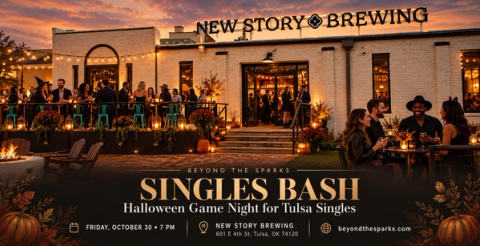
Next event · Singles Bash: Halloween Game Night for Tulsa Singles · Friday, October 30 · Tulsa · from $25.00 Reserve →
Start Your Free SPARK Quiz →