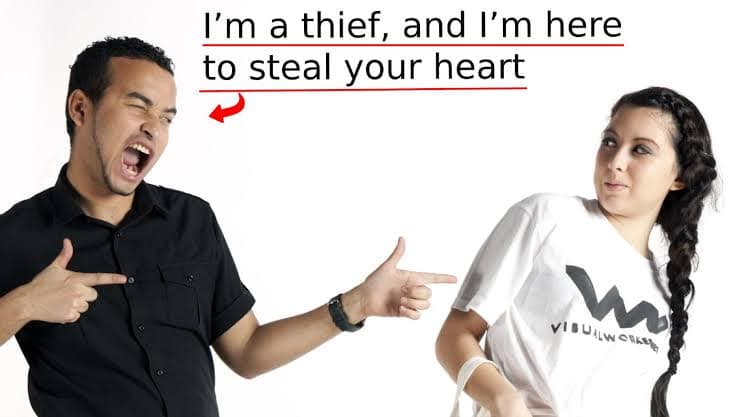

You have a line ready. You have been saving it for weeks, polished it in your head on the drive over, maybe even tested it on a friend who laughed politely and told you it was fine. You walk up, you deliver it, and the person across from you gives you the exact same smile they would give a stranger asking for directions.
That is not bad luck. That is the line doing exactly what the research says lines do.
Most people respond to that moment by concluding they need a better line. A sharper opener, a funnier hook, something with a higher hit rate. That instinct is understandable and, according to nearly forty years of research on the subject, almost exactly backwards.
The line was never the variable that mattered
One of the most cited studies on this, by psychologist Chris Kleinke and colleagues, sorted opening lines into three categories: flippant lines built for a laugh, direct lines that lead with a compliment, and innocuous lines that are just a low-key question, something like asking whether someone has seen a good movie lately [1]. Flippant lines, the clever, rehearsed, look-how-witty-I-am kind, came out least preferred of the three, by a wide margin [1].
Direct and innocuous lines did far better, and a related line of research on women's opening approaches found something even more specific. Straightforward questions like "do you want my number" or "are you single" outperformed cute or indirect openers, especially when the person delivering them was genuinely interested rather than performing [2]. The pattern across decades of this research is consistent. The more a line sounds rehearsed, the worse it does. The more it sounds like an actual person actually curious about you, the better it does.
What the newer research actually measured
A 2022 study published in the journal Evolutionary Psychology went further and tested a much wider set of flirting tactics head to head, not just opening lines but the whole toolkit, roughly 40 different tactics rated for effectiveness [3]. Humor came out on top. Warm smiles and sustained eye contact followed close behind. Clever openers and a great outfit, the two things most people spend the most energy on before a date, landed somewhere in the unremarkable middle of the pack [3].
The explanation researchers point to is something psychologists call emotional synchrony. When two people share a real laugh together, their brains are momentarily in the same emotional state at the same time, and that shared state is a large part of what people describe afterward as chemistry [3]. A rehearsed line cannot generate that, because by definition you already know how it ends before you say it. A genuine laugh, a real reaction, cannot be rehearsed by either person, which is exactly why it lands so much harder.
A good line gets you a smile. A real reaction gets you a second look.
What an innocuous question actually sounds like
The word innocuous makes this sound bland, so it helps to see what it actually looks like in practice. It is not a script. It is a real question, tied to something you can actually see or hear in the moment, that requires the other person to say more than one word back.
"What made you pick this spot?" works because it needs a real answer. "You look like you have a good story behind that" pointed at something specific, a tattoo, a band shirt, a drink order, works because it is observational, not generic. "Okay, you have to settle a debate, is a hot dog a sandwich" works purely because it invites a reaction, not a rehearsed one, from either person. None of these are clever. None of them are supposed to be. Their entire job is to hand the conversation back to the other person fast enough that whatever happens next is real.
Compare that to a flippant line built to land a laugh on its own. It does not need the other person to do anything except receive it, which is exactly the problem. A line that does not require a real response cannot produce a real reaction, and a real reaction is the entire thing the research says actually works.
Why the polished version keeps losing
Here is the part that is genuinely counterintuitive. Effort in the wrong place actively hurts you. A rehearsed line signals that you walked in with a plan for this exact moment, which is subtly the opposite of what flirting is supposed to communicate. Flirting works as a signal of real-time interest, this specific person, right now, is worth my attention. A line prepared in advance signals the opposite, that you had a script ready for whoever showed up.
Context matters too, and the research is honest about that instead of pretending one tactic wins everywhere. What works best splits by gender and by what someone is actually looking for. Signals of generosity and willingness to commit tend to work best for men pursuing something long-term, while for women, directness and clarity consistently outperform indirect or flippant approaches [3][2]. None of the effective tactics, across any of these studies, involve a clever pre-written line. They involve a real-time reaction to the actual person in front of you.
This is also why some people struggle more than others
A 2024 study in Personality and Individual Differences by Menelaos Apostolou and Elli Michaelidou surveyed 1,432 adults and looked at seventeen possible predictors of involuntary singlehood [4]. Poor flirting capacity showed up as one of the strongest factors for both men and women, alongside lower self-esteem and lower self-perceived mate value for men, and elevated choosiness for women [4]. Interestingly, conscientiousness, the personality trait tied to being organized and dependable, was positively linked to flirting skill for both genders [4].
That finding lines up with everything above. Flirting skill, in the way that actually predicts outcomes, is not about having sharper material. It is closer to a form of social attentiveness, noticing what is actually happening in front of you and responding to it in real time, rather than executing a plan. That is a learnable skill. It is just not the skill most people spend their energy practicing.
The strongest predictor is not what you say first. It is whether what you say next is a real response to them or a line you would have said to anyone.
There is a practical reading of that conscientiousness finding worth sitting with. It suggests flirting skill is not a fixed personality trait some people simply have and others do not. It behaves more like a habit built from paying consistent attention, the same trait that makes someone reliable at work or careful with follow-through. That is a genuinely useful reframe if you have ever written yourself off as bad at this. You are not missing a gene. You are probably just out of practice at noticing and responding to what is actually in front of you, which is a very different problem to solve.
What this looks like when it actually works
Strip the research down and the actual technique is almost embarrassingly simple. Ask a real question about something specific you noticed. Listen to the answer closely enough that your next line could not have been prepared in advance. Let yourself actually laugh when something is funny instead of performing a laugh. That is it. That is the whole technique that keeps outperforming decades of clever one-liners.
It works because it is unfakeable in a way a rehearsed line is not. Anyone can memorize a good opener. Almost nobody can fake genuine curiosity about a stranger for more than a few exchanges, which is exactly why it is such a reliable signal. The people who are good at this are not the ones with the best material. They are the ones paying the most attention.
If you do not think of yourself as naturally flirty
Most people who feel this way are not actually bad at the reacting part. They are bad at getting past the first ten seconds without freezing, which pushes them straight back to a rehearsed line out of sheer nerves. That is a different problem than the research above is describing, and it has a different fix.
The fix is lowering the stakes of the opener itself, not sharpening it. An innocuous question that fails just sits there quietly. A flippant line that fails is loud and embarrassing, which is exactly why it feels riskier to attempt the low-key version even though it performs better. Give yourself permission to ask something small and forgettable. The research says forgettable openers followed by real attention beat memorable ones followed by more performance, every time it has been measured.
Why this is easier at a Beyond The Sparks event than anywhere else
Here is the practical problem with all of this advice. Paying real attention and reacting genuinely is much easier said than done when you are nervous, standing across from a stranger, running through a mental checklist of what to say next. Nerves push people straight back toward rehearsed material, the exact thing the research says works worst.
This is part of why pre-matching changes the room at Cabin Boys Brewpub. Every guest has already been matched against another guest on values, attachment style, and relationship goals through the SPARK Quiz before either of them walks in [5]. That does not manufacture chemistry, we are not claiming it does, but it removes a huge amount of the anxiety that pushes people toward a rehearsed opener in the first place. You already know the person across from you is not a random stranger you have to win over from zero. You get to spend your ten minutes reacting to them instead of performing at them.
We hear a version of this from guests constantly. The ones who come back after a first event almost always say some version of the same thing, that they stopped worrying about what to say and just started talking. That is not an accident. It is what happens when the pressure to perform gets removed from the room.
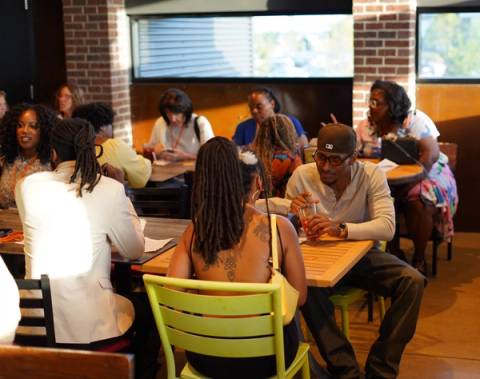
We watched this happen at a recent Friday event. Two guests sat down already knowing they had matched on values and pace through the quiz. Neither one opened with a line. One of them just asked what the other's drink was, got a real answer, made a real joke about it, and the table was loud within two minutes. Nobody planned that exchange. That is the entire point. The format cannot manufacture the reaction, but it clears enough of the performance pressure out of the way that a real one has room to happen.
The one-line version of all this research
If you remember nothing else, remember this. Every study above, across nearly forty years of research on the subject, points at the same conclusion from a different angle. The line does not matter. The reaction does. Humor beats cleverness, directness beats indirection, and genuine attention beats a rehearsed plan every single time it has been tested.
Cabin Boys Brewpub sits at 223 N Main St in the Tulsa Arts District, and most of what we described above happens over a shared beer list and a room loud enough to have an excuse to lean in. None of that is an accident either. A good room does some of the same work a good question does. It gives people something outside themselves to react to.
You do not need a better opener. You need less pressure to need one in the first place. That is easier to find in a room where the matching already happened before you walked in.
Take the SPARK Quiz at beyondthesparks.com. Five minutes, and it does the part that used to require a good line.
We will see you at Cabin Boys.
Sources
1. Forbes, "A Psychologist Reveals 3 Types Of 'Pick-Up Lines,' And Which Is Best" (Kleinke, Meeker, and Staneski opening-line typology). https://www.forbes.com/sites/traversmark/2024/07/15/a-psychologist-reveals-3-types-of-pick-up-lines--and-which-is-best/
2. Psychology Today, "Direct Is Best: What Makes Women's Pick-up Lines Work." https://www.psychologytoday.com/us/blog/the-mate-market/202003/direct-is-best-what-makes-womens-pick-up-lines-work
3. Technology Networks, "The Most Effective Flirting Strategies Detailed in New Study" (2022 Evolutionary Psychology journal study, 40 flirting tactics ranked). https://www.technologynetworks.com/neuroscience/news/the-most-effective-flirting-strategies-detailed-in-new-study-361338
4. Psychology Today, "The Key Predictors of Long-Term Involuntary Singlehood" (Apostolou and Michaelidou, 2024, Personality and Individual Differences). https://www.psychologytoday.com/us/blog/why-bad-looks-good/202402/the-predictors-of-involuntary-singlehood
5. Beyond The Sparks, "How the SPARK Profile Predicts Real Chemistry." https://beyondthesparks.com/blog/how-spark-profile-predicts-chemistry
Frequently Asked Questions
Rarely, and research consistently ranks them among the least effective openers. Flippant, rehearsed lines tested worst across decades of studies, while direct questions and genuine, unscripted reactions perform far better.
A 2022 study of about 40 flirting tactics found humor topped the list, followed by warm smiles and eye contact, well ahead of clever openers or outfit choices. The common thread is genuine, real-time reaction rather than rehearsed material.
Directness signals real interest in the specific moment, while a rehearsed line signals a script prepared for whoever showed up. Research on women's opening lines specifically found direct questions like "are you single" outperformed indirect or flippant approaches.
It removes a lot of the anxiety that pushes people toward rehearsed lines in the first place. Since guests are already matched on compatibility before the event, the conversation can start from genuine reaction instead of a performance aimed at winning over a stranger from zero.
Ready to Find Your Match in Tulsa?
Take the free SPARK Quiz and join us at our next event. Everyone leaves with at least one match.
Next event · Singles Bash: Halloween Game Night for Tulsa Singles · Friday, October 30 · Tulsa · from $25.00 Reserve →
Start Your Free SPARK Quiz →