You're at Mother Road Market on a Saturday, splitting a slice of Andolini's with a friend, and you spot him at the Hop Stop counter. He sees you. You both nod. Neither of you smiles.
Three months ago he was sleeping over twice a week. Two months ago he stopped answering after 10 p.m. One month ago you told yourself it was fine.
It was not fine.
If you live in Tulsa or OKC and you've dated in the last two years, you already know this scene. The names change. The brewery changes. The story does not. We are all running into the same ghost at the same farmers market, and we are all calling it the same thing.
A situationship.
What the big apps say about situationships
The dating apps have made situationships their headline trend for two years running. Hinge's 2025 D.A.T.E. Report surveyed thousands of Gen Z daters and flagged a "question deficit" at the heart of the problem, where most daters believe they ask thoughtful questions on a first date while far fewer feel their partner does the same [1]. The result is the gray zone we now call a situationship, where neither person ever asks the question that would close it.
Bumble built its 2025 trend report off responses from more than 40,000 Gen Z and millennial members. The headline finding was that nearly 2 in 3 (64%) women are getting clear about what they want, and 59% are placing more value on a partner who is emotionally consistent and reliable [2]. Bumble framed situationships as part of the "murkiness" people are tired of, not a state they want to stay in.
Match's 14th annual Singles in America study landed in June 2025 and the data points the same direction. The willingness to tolerate ambiguity has dropped, and 62% of singles now say they want a committed, exclusive relationship [3]. Match also reported that 53% of singles describe themselves as emotionally exhausted by the process [3].
So the apps know. They have published the reports, sold the trend pieces, and run the ads about "designed to be deleted". And yet the situationship problem hasn't gone anywhere, because the apps that named it are also the apps that built the conditions for it. Endless swiping, low-effort matches, and the option to keep three other conversations going while you decide. That is the engine. The trend report is just the dashboard light.
There is one more layer the trend reports tend to skip. The national data is drawn from cities where the dating pool is functionally infinite, so the situationship there is a choice between something and something else. In a smaller market the choice looks different, because the alternative on the swipe carousel is the same six faces you saw last week. That is where Tulsa and OKC start to break the trend report's assumptions.
Why Tulsa and OKC make it worse
National dating coverage tends to assume New York and LA defaults. A million strangers on the train. Twenty new bars opening every month. A clean break is a Brooklyn move away.
If you date in Tulsa or OKC for a year, you will see every person you've ever dated again, and you'll see them at the place where the third date happened. Brady Arts District. Cherry Street. Plaza District. Midtown. The whole singles scene runs through the same handful of zip codes.
That changes the math on a situationship in three specific ways.
First, the pool is smaller and you feel it fast. Tulsa metro counts about 410,000 people and OKC metro counts roughly 700,000, but the active singles scene in both cities funnels through the same dozen neighborhoods. Active daters here cycle through their realistic matches in weeks, not months, and when the next option starts to feel thin the current ambiguous thing starts to look like a safer bet than it is.
Second, social circles overlap in a way that big cities don't replicate. You met him through your coworker's roommate. Her sister works with your boss. The mutual friend list on Instagram is six people deep before you've gone on a second date. Ending a situationship in Tulsa or OKC means doing it in front of an audience that will absolutely notice, and that pressure keeps a lot of people stuck in the gray zone longer than they should be.
Third, the venues are shared. There is one Cabin Boys. There is one Guthrie Green concert series. Scissortail Park has one big lawn. If you have a Sunday routine at Coffee House on Cherry Street, your situationship has the same Sunday routine. Avoiding someone here is a part-time job, and reconciling with someone here is a public event.
Add it up and you get a specific Oklahoma flavor of the trap. You don't drift out of a situationship the way the New York Times trend piece describes. You bump into it at a Drillers game. You watch it date someone you know. You drive past its car at QuikTrip and feel something you don't want to feel.
And the apps keep telling you the answer is a better profile photo.
There is a quieter cost too. Every situationship that ends without a real conversation takes a chunk of trust with it, and small cities cannot afford that the way big cities can. When the same bartender at Bird and Bottle has seen you on four first dates this quarter, you start to dread the next one. You stop trying as hard. The pool shrinks again, this time from the inside.
The four signs you're already in one
Most people don't realize they're in a situationship until month four. By then the sunk cost is doing the talking. Here are the early tells.
The plans are always last minute
You hear from them Thursday night for a Friday hang. You hear from them Saturday at 9 p.m. for a Saturday at 10 p.m. plan. You never get a Tuesday text that says "want to grab dinner this weekend". The calendar stays empty until the last moment, because keeping it empty is the point.
You haven't met anyone in their life
No friends. No roommate. No coworker who waved at you at Topeca. After two months, this is data. People who want a real thing introduce you to the people who matter to them, and they do it early. The absence is the answer.
The conversation never gets serious
You talk about the bar you went to. You talk about the show you're watching. You do not talk about what either of you wants in six months. Any attempt to go deeper gets a joke, a topic change, or a "we don't have to define everything". That last line is the tell. People who want clarity reach for it.
You feel anxious more than you feel happy
Psychology research on ambiguous relationships keeps finding the same thing. The uncertainty itself is what creates the stress, and the anxious partner stays anxious while the avoidant partner stays comfortable [4]. If you spend the hour after every hang reading the texts again, that is not chemistry. That is your nervous system telling you the structure is wrong.
What ends a situationship (and what doesn't)
The standard advice is "have the DTR conversation". Define the relationship. Ask the question. Force the issue.
Sometimes that works. Often it doesn't, because the person avoiding the conversation has been avoiding it on purpose, and asking them at month four just gives them a script to say what you want to hear for another month. The DTR works when both people already want the same thing and one of them is just waiting for permission. The DTR fails when you wanted different things from week two.
The real fix is upstream. You skip the situationship by sorting for compatibility before the first kiss, not after the third month. People who match on values, lifestyle pace, and what they actually want out of dating don't end up in three-month gray zones, because the question of "what is this" already has an answer when they sit down.
Think about how a non-dating friendship works. You meet someone at a run club, you both show up because you both like running, and the shared frame is set before you say hello. Nobody runs three months of laps wondering if the other person is actually into running. The frame did the work.
Dating broke this on purpose. The apps stripped the frame out, because a frame would shrink the engagement numbers. We are putting the frame back.
Why compatibility events skip the trap
We start every match with the [SPARK Quiz](https://beyondthesparks.com/spark-quiz). It is short, it is honest, and it asks the things you would only learn about someone on date five. How you handle conflict. What you want your weekends to look like. Whether you want kids. Whether you want a partner who is fine with you having a quiet Friday in.
We use those answers to match you with someone whose answers line up. Not someone you swiped right on at a stoplight. Someone whose actual life and actual goals fit yours.
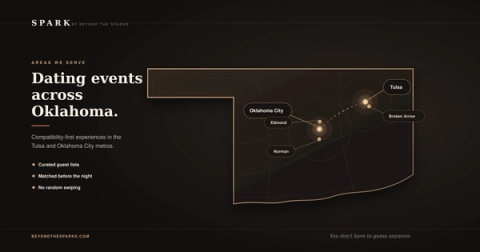
Then we put you in the same room. Our events run at [Cabin Boys Brewery in Tulsa](https://beyondthesparks.com/events), and we are bringing the format to OKC singles too. You walk in knowing the people in that room opted in to the same thing you opted in to. Real chemistry. In person. Looking for something that lasts longer than a season.
Because everyone is sorted before they show up, the "what are we" question is answered before the first hello. You are both there because you said yes to the same idea. That is the trap door under the situationship. The structure that lets ambiguity flourish is gone before the night starts.
You still have to like each other. Chemistry is chemistry, and we cannot fake that for you. But you will not spend three months wondering if the person across from you wants a relationship, because they already told us they do.
We host in Tulsa now and we are running our first OKC nights this summer. Same format. Same quiz. Same rule about who gets in the room. If you have been carrying a situationship around for a season or two, this is the off-ramp. It is the one Saturday where you don't have to wonder.
Sources
1. Hinge, 2025 D.A.T.E. Report. https://hinge.co/newsroom/2025-GenZ-Report 2. Bumble, 2025 Global Dating Trends Report. https://bumble.com/en-us/the-buzz/bumble-dating-trends-2025 3. Match and The Kinsey Institute, 14th Annual Singles in America Study, June 2025. https://match.mediaroom.com/2025-06-10-Match-and-The-Kinsey-Institute-Unveil-14th-Annual-Singles-in-America-Study 4. Nafsology, From Ambiguity to Anxiety, Understanding Situationships and Their Psychological Impact. https://nafsology.ae/from-ambiguity-to-anxiety-understanding-situationships-and-their-psychological-impact/
Ready to Find Your Match in Tulsa?
Take the free SPARK Quiz and join us at our next event. Everyone leaves with at least one match.
Next event · Dallas SINGLES MIXER (Slow Dating > Speed Dating) · Saturday, September 19 · 2965 S. Hwy 161, Grand Prairie, TX 75052 (Located in the EpicCentral entertainment district) · from $35.00 Reserve →
Start Your Free SPARK Quiz →