Not long ago, admitting you used a dating service was quietly embarrassing. You didn't bring it up at dinner. You definitely didn't tell your parents. Meeting someone through Match.com carried the unspoken implication that you had run out of better options.
Then the pandemic happened, and everything changed.
The pandemic made dating apps normal. It also broke something.
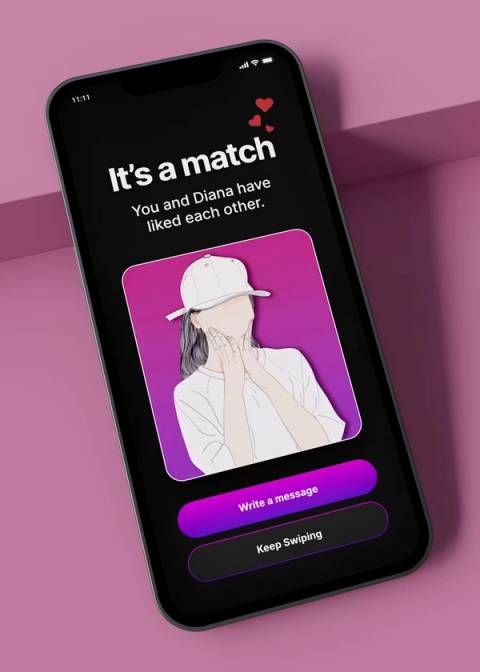
Lockdowns pushed millions of people who would have never looked twice at a dating app into signing up for one [1]. Swiping became normal. Meeting strangers online stopped being something you had to explain away. For a while, it worked. But the longer people stayed on these platforms, the more the cracks showed. The apps made it easy to connect with someone and equally easy to dump them for the next profile. There's always another option two swipes away, and that feeling quietly destroys the ability to commit to anyone.
User fatigue, disappointment, and large-scale abandonment of online services have followed [2], and in their wake, face-to-face personal matchmaking has surged back into demand.
We hear a quieter version of that same arc from almost every guest who walks through the door at Cabin Boys. Someone downloaded three apps in 2020 because almost everything else was closed, matched with dozens of people over the following year, and at some point lost track of the last time a match actually turned into a second date. The volume was never the problem. The lack of any real filter before that volume hit their phone was.
How big the matchmaking comeback actually got
The U.S. matchmaking industry now includes over 2,000 professional firms of varying sizes, skill sets, and pricing models [3] and that's before you count the friends, parents, and coworkers who have made it their personal mission to set you up.
That figure comes from Marketdata Enterprises, the research firm that has tracked the matchmaking and personals industry for decades, and it sits inside a bigger number. The firm puts the international matchmaking market at $1.2 to $1.5 billion, with roughly 40 percent of that revenue generated inside the United States alone [3]. An industry that size does not survive on nostalgia for a pre-app era. It survives because enough people decided an algorithm optimized for engagement was never actually built to solve their problem.
The corporate end of that industry is worth understanding on its own terms, not just as the cheap alternative to the boutique tier. Volume matchmaking chains run on standardized intake questionnaires, a rotating pool of coaches rather than one dedicated matchmaker, and packages priced closer to a few thousand dollars than a few hundred thousand. That model gets criticized, often fairly, for feeling like a slightly more expensive dating app with a human forwarding the profiles instead of an algorithm. The boutique end exists specifically because enough clients decided that criticism was accurate and were willing to pay for something closer to an actual person doing the filtering, not a template with a human face on it.
Neither tier is really selling introductions in the way a dating app sells matches. Both are selling the removal of bad options before you ever have to sit across from one, which is a fundamentally different product than a bigger pool to choose from. The price difference between the two tiers is mostly a difference in how much human attention goes into that removal process, not a difference in what is actually being promised.
The $50,000 to $250,000 tier, and who is actually paying it
At the lower end, you have large corporate chains doing volume business with standardized packages. At the high end, you have boutique firms charging numbers that look like a typo. The highest-end players in this space are perfectly comfortable charging between $50,000 and $250,000 for their services with no strings and no guarantees attached [4][5][6] and they are growing their revenue every year.
Those numbers are not exaggeration for effect. Silicon Valley matchmaking firm Linx Dating tells clients its packages start at $150,000 and go up from there depending on how much hands-on searching the engagement requires [5]. On the more traditional end of that same industry, firms built around a structured six-month engagement, like Agape Matchmaking, run closer to $30,000 to $50,000 [6]. The headline-grabbing top end, the $250,000 figure making the rounds in business press, is being driven by a specific and fairly new client base [4].
Who's paying these prices? The specific targets are tech-created millionaires with huge amounts of money, no time, no social experience, and no idea how to find a partner. AI IPOs and crypto deals have created a wave of newly rich people who are, by most accounts, completely unprepared for dating [4][5]. And since they're used to paying for solutions to hard problems, they pay.
Business press covering this trend has landed on a blunt way of describing that client base: rich, busy, and clueless [4]. It is not an insult so much as an accurate summary of a specific life stage. Someone who spent the last several years heads-down building or investing in a company through an AI valuation run or a crypto cycle often has not had the unstructured social time that dating actually requires, and arrives at thirty-five or forty with a net worth that outpaces their dating experience by a wide margin. Paying a matchmaker is the same instinct that already worked for every other hard problem in their life: hire the best available expert and let them handle it.
Notice what none of those retainers include: an actual guarantee. The original terms are blunt about it, no strings and no guarantees attached, and that is not fine print buried in a contract, it is close to standard across the industry. You can pay $250,000 and still not find anyone. The product being sold is effort and access, not an outcome.
The higher the price tag climbs, the less matchmaking is actually about the matchmaker, and the more it is about buying back a filter money cannot otherwise create.
What the ultra-rich are actually buying
There's something revealing in all of this. It's not really about the matchmakers. It's about what people want underneath the whole thing: someone who actually knows them, who filters on their behalf, who removes the noise [7]. That's what the apps promised and never quite delivered.
Research on real speed dating backs up why that filtering step matters more than raw access to a bigger pool of people. A 2022 study published in the Proceedings of the National Academy of Sciences followed more than 6,600 actual speed dates and found the strongest predictor of later romantic interest was not general attractiveness or a longer list of matches. It was the specific fit between two particular people, something researchers call relationship effects [7]. You cannot see that fit in a profile photo, and an app that just shows you more photos, faster, is not actually addressing it.
A six-figure matchmaker and a well-run compatibility event are, underneath two very different price tags, trying to solve exactly that same problem: finding relationship effects before two people ever sit down, instead of hoping enough swiping eventually surfaces one. The apps were never built to do that. They were built to maximize time spent in the app, which is a different, and often opposite, incentive from getting you off the app quickly with someone who actually fits.
The intake interview vs. the five-minute quiz
A traditional matchmaker's process usually starts with a long, sometimes multi-hour intake interview, values, deal-breakers, relationship history, what has not worked before, followed by a human being manually comparing that profile against a private roster of other clients to find a plausible match. It is genuinely thoughtful work, and it is exactly why it is expensive. Someone's hours are the product.
The free SPARK Quiz compresses that same intake into five minutes and twenty-four questions, sorting each person into one of sixteen SPARK types across five dimensions: social energy style, partnership values, attachment pattern, relationship vision, and conflict or connection style. It is not a human conducting an hours-long interview. It is a structured version of the same questions a good matchmaker would ask, run at a scale a $50,000 retainer was never designed to reach.
Run the math side by side and the gap is not subtle. A single client at the low end of the boutique tier pays roughly $30,000 to $50,000 for one matchmaker's attention over six months [6]. A Beyond The Sparks guest pays nothing for the equivalent filtering step, then the price of a single ticketed night out to actually meet the people that filtering surfaced. The quiz is not a watered-down version of what the $250,000 client is buying. It is the same underlying mechanism, priced for a metro area instead of a venture-backed net worth.
You do not need a six-figure retainer to get the same thing
The good news is you don't need a six-figure retainer to get that experience. Compatibility-first events where the work of sorting is done before you walk through the door give you the same thing at a fraction of the cost and with actual humans in the room.
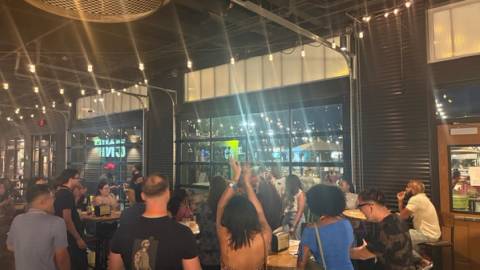
That is the entire premise behind Beyond The Sparks. Before anyone shows up to an event at Cabin Boys Brewpub in the Tulsa Arts District, or at Chicken N Pickle in Oklahoma City, they take that same five-minute SPARK Quiz. It is doing the same filtering job a $50,000 matchmaker's intake interview does, just without the retainer or the multi-hour meeting.
We wrote separately about why we are comfortable calling that model a matchmaker, and about what a traditional Tulsa matchmaker actually charges if you would rather go that route locally [8][9]. The short version holds up next to everything above. Every guest who attends a Beyond The Sparks event leaves with at least one match, most leave with two or three, verified the same night. You do not need to be a newly minted AI millionaire to access a real filter before you meet someone. You need five minutes and a Friday night.
That distinction matters more than the price gap. Beyond The Sparks' match guarantee, every guest leaves with at least one match, is not a marketing flourish borrowed from an industry that famously does not offer one. It is a direct answer to the exact gap the $250,000 tier leaves open. A cheaper filter that actually promises an outcome beats an expensive one that promises only effort.
Tulsa and Oklahoma City are not Silicon Valley, and most of the people reading this are not sitting on a post-IPO net worth. But the underlying problem the six-figure matchmaking tier is being paid to solve, too many low-quality options and no real way to filter them, is the same problem showing up in a much more ordinary form in both cities' dating pools. The fix does not have to cost what it costs in San Francisco.
Take the SPARK Quiz at beyondthesparks.com. It is the same filtering work the $250,000 tier is selling, done for free.
We will see you at Cabin Boys, no retainer required.
Sources
1. Match Group, Form 8-K business update, March 31, 2020 (Tinder single-day swipe record during pandemic lockdowns). https://www.sec.gov/Archives/edgar/data/1575189/000157518920000023/mtch8-k20200331ex991.htm
2. Forbes Health and OnePoll, Dating App Burnout Survey, 2024. https://www.forbes.com/health/dating/dating-app-fatigue/
3. Marketdata Enterprises, "The $1.2-1.5 Billion International Matchmaking Market Survives the Pandemic," via MarketResearch.com. https://blog.marketresearch.com/the-1.2-1.5-billion-international-matchmaking-market-survives-the-pandemic
4. Howard Tullman, "Rich, Busy, and Clueless: The New Clients Fueling a $250,000 Matchmaking Boom," Inc.com. https://www.inc.com/howard-tullman/online-dating-us-matchmaking-industry-ai-millionaires/91379688
5. SF Standard, "$150K to find love? Inside the high-stakes Silicon Valley matchmaking scene," March 29, 2025. https://sfstandard.com/2025/03/29/silicon-valley-matchmakers-bay-area/
6. CBS News, "Tired of dating apps? More single people are turning to matchmakers to find love." https://www.cbsnews.com/news/tired-of-dating-apps-more-single-people-are-turning-to-matchmakers-to-find-love/
7. Baxter, A., Maxwell, J. A., Bales, K. L., Finkel, E. J., Impett, E. A., and Eastwick, P. W. (2022). Initial impressions of compatibility and mate value predict later dating and romantic interest. PNAS. https://www.pnas.org/doi/10.1073/pnas.2206925119
8. Beyond The Sparks, "Yes, We're a Matchmaker. Here's Why That's a Good Thing." https://beyondthesparks.com/blog/beyond-the-sparks-matchmaker-tulsa
9. Beyond The Sparks, "Looking for a Matchmaker in Tulsa? Here's What's Actually Available in 2026." https://beyondthesparks.com/blog/tulsa-matchmaker-guide
Frequently Asked Questions
It varies enormously. Traditional six-month matchmaking programs run roughly $30,000 to $50,000, and the top end of the Silicon Valley matchmaking scene can reach $150,000 to $250,000 depending on the firm. Beyond The Sparks' free SPARK Quiz performs the same filtering work at no cost.
Post-pandemic dating app fatigue is well documented, with one 2024 survey finding 78 percent of active dating app users report burnout. As trust in the apps' filtering declined, demand for a human, pre-screened alternative grew, and the U.S. matchmaking industry now includes an estimated 2,000-plus professional matchmakers.
Reporting on the trend points to a specific new client base: people who became newly wealthy from AI company valuations, IPOs, or crypto, who have significant money and very little dating experience or time.
Yes, functionally. The free SPARK Quiz performs the same compatibility-screening role a traditional matchmaker's intake interview does, just without the retainer.
Ready to Find Your Match in Tulsa?
Take the free SPARK Quiz and join us at our next event. Everyone leaves with at least one match.
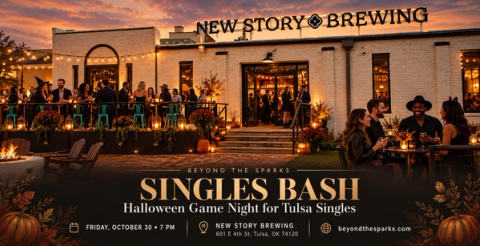
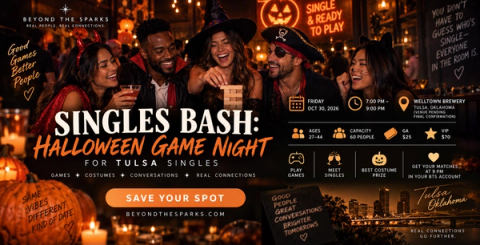
Next event · Singles Bash: Halloween Game Night for Tulsa Singles · Friday, October 30 · Tulsa · from $25.00 Reserve →
Start Your Free SPARK Quiz →