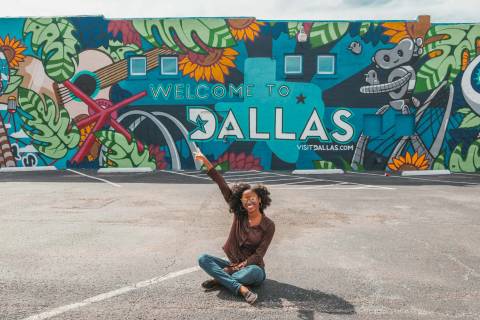

Before we open Beyond The Sparks in a new city, we do the same thing every time: we stop guessing and actually look at the market. Dallas is next, launching in September, and what we found researching it was blunter than we expected. Dallas does not have a dating problem because it lacks singles or nightlife. It has a dating problem because of exactly the kind of noise a filtering-first format is built to cut through.
Here is what the research actually says about dating in Dallas right now, before we say anything about what we are bringing there.
This is not a marketing exercise dressed up as research. We do this same homework before every launch, because a filtering-first format only works if we understand what it is actually filtering. Dallas turned out to have a clearer, more well-documented version of the problem than either Tulsa or OKC did before we opened there.
The reputation is not great, and it is not just internet noise
This is not a fringe opinion buried in a subreddit. D Magazine ran a dedicated look at dating in Dallas and gave the scene a C grade, pointing to a below-average singles population relative to the metro's size, an above-average cost of living, and thin nightlife and entertainment options for a city this large [1]. The Dallas Observer went further, running a piece titled bluntly "Dallas' Dating Scene Is Only Getting Worse," tying part of the decline to a widening cultural and political divide making it harder for people to connect across different circles [2].
Independent rankings back up the local coverage rather than contradicting it. WalletHub's 2026 Best and Worst Cities for Singles ranked Dallas 88th out of more than 180 cities, well behind Austin at 6th and Houston at 46th, two cities Dallas gets compared to constantly and measured against every year [3]. A separate Zumper ranking placed Dallas 50th out of 100 cities studied, giving it decent marks for restaurants and income but a D grade for entertainment options per capita [4].
Two different methodologies, two different survey years, and both land Dallas well outside the top tier of American cities for singles. That consistency matters. A single bad ranking could be noise, a quirk of one study's weighting. Two independent rankings agreeing that Dallas underperforms for its size is closer to a real signal.
The math behind the mismatch
Dallas County's population runs close to even by sex, roughly 98.3 men for every 100 women according to Census Bureau estimates, which on paper suggests a fairly balanced dating pool [5]. The problem the local coverage keeps circling back to is not a raw numbers mismatch. It is that a metro approaching 8.5 million people across the full Dallas-Fort Worth area produces a dating pool too large and too scattered for any one person to actually navigate without serious noise getting in the way [6].
That is the same pattern we wrote about recently regarding smaller cities like Tulsa: past a certain size, adding more people to an unfiltered dating pool does not add real options, it adds friction. Research on choice overload backs this up directly, participants in dating-specific studies became progressively more likely to reject potential matches the more profiles they browsed, with acceptance likelihood dropping by roughly 27 percent from the first profile evaluated to the last [7]. Dallas, at nearly ten times Tulsa's metro size, is exactly the kind of market where that effect compounds instead of resolving itself.
There is a geography problem layered on top of the pure numbers problem too. Dallas-Fort Worth is not one dense, walkable core the way downtown Tulsa or even downtown OKC largely is. It is a sprawling collection of distinct areas, Uptown, Deep Ellum, Bishop Arts, the northern suburbs, spread across a metro big enough that two compatible people can easily live forty-five minutes apart and never cross paths without something actively bringing them together. Size alone does not just add noise. It adds physical distance between the exact people who would otherwise be a good match.
Dallas does not have too few singles. It has too much noise between the singles who would actually work.
What the bad reputation actually gets wrong
None of this means Dallas lacks good people worth meeting. A C grade and an 88th-place ranking describe how hard the current process is, not the quality of the people stuck inside it. A metro approaching 8.5 million people has plenty of genuinely compatible singles in it. The reputation problem is a process problem, too much noise between reasonable people, not a shortage of reasonable people to begin with.
That distinction matters because it changes what actually needs fixing. A city with genuinely few eligible singles needs more people. A city with plenty of eligible singles buried under noise needs better filtering, and Dallas is unambiguously the second kind of problem based on everything the local coverage and the rankings describe.
Where the market already looks for something better
Dallas is not short on people trying to solve this. Several matchmaking and dating-event companies already operate there, from national names like Three Day Rule and It's Just Lunch to Dallas-specific outfits like the Dallas Dating Company and The Matchmaking Company. That existing market tells us two things worth stating plainly. First, there is real, proven demand in Dallas for something more curated than the apps. Second, most of what already exists there runs on the traditional matchmaker model, a paid intake process built around one client at a time, not a free, quiz-based filtering step that scales to a full room of matched guests in one night.
That gap, real demand for curated introductions without a five-figure retainer standing between a person and the process, is precisely the gap the SPARK Quiz was built to close everywhere we run it. Dallas is simply the biggest, most extreme version of the problem we have already solved at a smaller scale in Tulsa and OKC.
It is worth being specific about what that existing market actually charges, since it explains why demand for something different exists in the first place. Traditional matchmaking programs nationally run anywhere from $30,000 for a structured six-month engagement up to $150,000 or more at the boutique end, and Dallas's matchmaking firms generally sit inside that same range. That price point puts real matchmaking out of reach for the large majority of Dallas singles, regardless of how badly the local dating scene needs exactly the kind of filtering those firms provide.
Where a Dallas event would actually make sense
Deep Ellum stands out immediately as a neighborhood built for exactly this kind of night, a dense live-music and nightlife district with a real walkable core, the kind of built-in activity and energy that made Chicken N Pickle work so well for our OKC launch. Bishop Arts District offers a quieter, more boutique alternative, wine bars and independent restaurants closer in spirit to Cabin Boys' brewpub atmosphere than to a loud club scene.
Either neighborhood solves the same problem the sprawl creates: a single, walkable center gravity strong enough to pull guests in from across a metro that otherwise keeps people forty-five minutes apart. That concentration is not incidental to how our format works. It is the entire reason a venue choice matters as much as the matching algorithm behind it.
We are not committing to a specific venue publicly yet, that decision follows the same careful process we used scouting Chicken N Pickle before the OKC launch, touring real spaces and picking the one that solves the actual problem instead of the one that was simply available first [8]. What we can say is that Dallas has no shortage of neighborhoods built for the kind of night our format depends on.
What will not change when we get there
The free SPARK Quiz, the twenty-four questions, the sixteen SPARK types across social energy, values, attachment pattern, relationship vision, and conflict style, travels to Dallas exactly as it exists in Tulsa and OKC today. Matched conversation rounds instead of blind mingling, and the same guarantee, every guest leaves with at least one real match, hold regardless of which metro's noise the format is cutting through.
A market ten times the size of Tulsa's does not need a different product. It needs the same filtering mechanism applied to a much bigger, much noisier pool, which is exactly what a metro this size is missing right now according to its own local press.
If anything, the filtering matters more in a market this size, not less. In Tulsa, a thin dating pool means the SPARK Quiz is refining an already-manageable set of options. In Dallas, it is doing the much heavier lifting of cutting an overwhelming, sprawling pool down to the three to five people actually worth a conversation, which is closer to the core problem the local press keeps describing without a clear solution attached.
Why September, and why now
We are not launching in Dallas because a market that size is an obvious growth target on a spreadsheet. We are launching because the specific problem Dallas has, real singles, real demand for something better, and a process too noisy and too spread out for people to actually use, is the exact shape of problem our format was built to solve. Tulsa proved the model works in a small, dense market. OKC proved it scales to a bigger one. Dallas is the test of whether it holds up in a market defined by sprawl and noise rather than just size.
That is also why we are not rushing a launch date earlier than September. Getting the guest pool large enough to make the match guarantee hold up in a metro this size takes more lead time than it did in OKC, and we would rather take that time now than launch thin and have Dallas's first cohort experience exactly the kind of scattered, low-quality process the local coverage is already describing.
What we could not confirm, and said so
We did not find a Dallas-specific or Texas-specific dating app burnout statistic to sit alongside the national figure we usually cite, 78 percent of active dating app users reporting burnout [9]. Rather than assume the number holds locally and present it as confirmed, we are saying plainly that no Dallas-specific version of that stat exists in the research we could verify. The reputational and ranking data above stands on its own regardless.
That kind of honesty about what we do and do not know is part of the same process we ran before opening in OKC. We would rather tell you plainly what the research supports and where it runs out than round up to a number that sounds more persuasive but is not actually verified.
If you are in Dallas and want to be part of the first cohort this September, message us at beyondthesparks.com. The SPARK Quiz will work exactly the same as it does in Tulsa and OKC today, and taking it now means you are ready the moment the first Dallas event is announced.
We will see you in Dallas this September, filtering out the noise the same way we have in every city so far.
Sources
1. D Magazine, "Dating in Dallas," April 2026. https://www.dmagazine.com/publications/d-magazine/2026/april/dating-in-dallas-dallas/
2. Dallas Observer, "Dallas' Dating Scene Is Only Getting Worse as Political Divide Grows," September 22, 2025. https://www.dallasobserver.com/arts-culture/dallas-dating-scene-is-only-getting-worse-as-political-divide-grows-22494994/
3. WalletHub, "Best & Worst Cities for Singles, 2026." https://wallethub.com/edu/best-worst-cities-for-singles/9015
4. Zumper, Best Cities for Singles ranking, 2025. https://dallas.culturemap.com/news/city-life/best-cities-for-singles-2025/
5. Neilsberg, Dallas County, TX Population by Gender (U.S. Census Bureau ACS 2019-2023 5-Year Estimates). https://www.neilsberg.com/insights/dallas-county-tx-population-by-gender/
6. U.S. Census Bureau, Vintage 2025 metro area population estimates (Dallas-Fort Worth-Arlington MSA). https://www.census.gov/newsroom/press-releases/2026/2025-popest-metro-micro-counties.html
7. Pronk, T. M., and Denissen, J. J. A. (2020). A rejection mind-set: Choice overload in online dating. Social Psychological and Personality Science, 11(3), 388-396. https://journals.sagepub.com/doi/10.1177/1948550619866189
8. Beyond The Sparks, "Why We Decided to Bring Beyond The Sparks to Oklahoma City." https://beyondthesparks.com/blog/why-beyond-the-sparks-expanded-to-okc
9. Forbes Health and OnePoll, Dating App Burnout Survey, 2024. https://www.forbes.com/health/dating/dating-app-fatigue/
Frequently Asked Questions
Local coverage and independent rankings both suggest so. D Magazine gave the Dallas dating scene a C grade, and WalletHub ranked Dallas 88th out of more than 180 U.S. cities for singles in 2026, well behind comparable Texas cities like Austin.
September 2026. Exact venue and launch date details are still being finalized, but the SPARK Quiz, matched conversation rounds, and match guarantee will be identical to Tulsa and OKC.
Yes, including national chains like Three Day Rule and It's Just Lunch, and Dallas-specific firms like the Dallas Dating Company. Most run on a traditional paid-intake matchmaker model rather than a free, quiz-based format that matches a full room of guests at once.
Research on choice overload suggests that very large, unfiltered dating pools produce more browsing and rejection rather than better outcomes. A metro of nearly 8.5 million people can mean more noise between compatible people, not fewer obstacles to finding them.
Ready to Find Your Match in Tulsa?
Take the free SPARK Quiz and join us at our next event. Everyone leaves with at least one match.
Start Your Free SPARK Quiz →