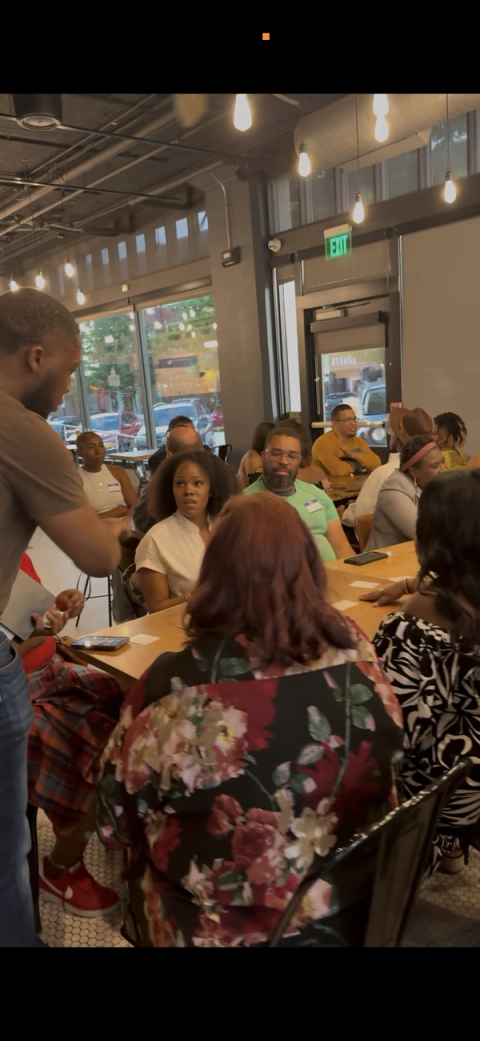
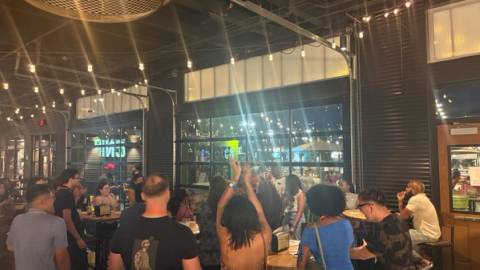
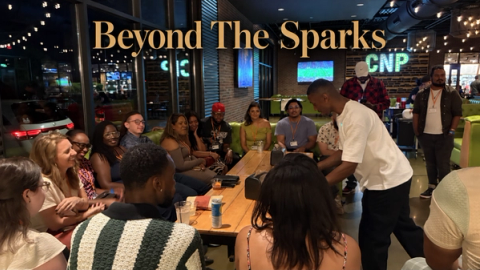
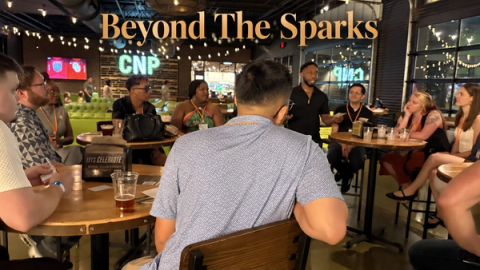
By seven thirty, the courts at Chicken N Pickle in Grand Prairie were full, the bar was three deep, and forty-five people who had never met each other were somehow already loud enough to hear over the paddle-on-ball echo bouncing off the ceiling. That was the scene at Beyond The Sparks' first Dallas-area event, and if you were waiting for the "we'll iron out the kinks next time" version of a first event in a new city, this wasn't it.
We've run enough of these nights now, in Tulsa, in Oklahoma City, to know roughly what a good one feels like from the door. This one felt good before the first quiz check-in even finished.
The common assumption about a brand's debut in a new market is that the first night is rough. Small crowd, awkward energy, a few things that don't quite work yet. Ours wasn't that. Forty-five guests showed up, every single one left with a match, and by the end of the night we were the ones getting thanked.
Where it happened, and why the venue mattered
Chicken N Pickle's Grand Prairie location sits inside the EpicCentral Entertainment District at 2965 S. Highway 161, eleven pickleball courts split across indoor, covered, and open-air space, a full restaurant, two bars, and enough room to let a crowd spread out without ever feeling scattered [1]. The chain itself turns ten this year, having opened its first location in Kansas City back in 2017 around a simple bet: pickleball plus scratch-made food plus a real bar would pull people out of their apartments and into a room together [2]. That bet is exactly why the venue worked for us. It's built for the same thing our events are built for, giving strangers a shared, low-pressure activity to stand around instead of a formal dinner table to perform across.
That distinction matters more than it sounds like it should. A quiet restaurant puts all the pressure on conversation from minute one. A room with pickleball courts, a full bar, and yard games gives people something to do with their hands and their attention while the actual connection builds underneath it, the same principle behind why activity-based first dates consistently outperform sit-down ones.
Six people, one dinner, and what that room felt like
Six guests opted into the VIP Dinner, a smaller, more intentional room off to the side of the main event, and it had a completely different texture than the larger crowd. Fewer people means less room to hide behind small talk, and it showed. Conversations went deeper faster. Nobody was working the room looking for the next person to talk to, because the room was small enough that everyone already knew who was in it.
That's not an accident of numbers. It's the same logic behind why an event this size works better than a packed bar with three hundred strangers in it. Compatibility filtering already happened before anyone walked in, through the SPARK Quiz, so a room of six people who've all been pre-sorted for real compatibility produces a fundamentally different kind of night than six strangers who happened to end up at the same table.
Smaller rooms also change how people behave, not just how they feel. In a crowd of forty-five, it's easy to have one good conversation and coast on it for the rest of the night. In a room of six, that option doesn't really exist. Everyone ends up talking to almost everyone else at some point, which means the dinner guests left with a much broader read on the group's overall compatibility than most main-floor guests would get in the same two hours.
What the night actually looked like, hour by hour
Doors opened at six thirty, and the first hour was deliberately unstructured, guests trickling in, checking in against their SPARK Quiz results, grabbing a drink, and getting oriented to a venue most of them had never set foot in before. By seven, the room had filled in enough that the natural rotation started happening on its own, small groups forming around the courts, conversations starting over a shared game instead of a forced icebreaker.
That structure isn't accidental. A landmark study on choice overload found that when people are handed too many unstructured options at once, they tend to freeze rather than engage, overwhelmed by the sheer number of directions a room could go [3]. Pickleball courts solve that problem by design. Nobody has to decide who to talk to first, because the game decides the next few minutes for them. By the time a rotation ends, two people who might never have approached each other across a static room have already spent ten minutes laughing about a missed shot.
The VIP Dinner ran on a parallel track starting around seven thirty, six guests seated together in a quieter section of the restaurant, insulated from the noise of the main floor but still close enough to feel like part of the same night rather than a separate event entirely. By eight thirty, the two tracks had blended back together, dinner guests wandering over to the courts, main-event guests drifting toward the bar, the whole room operating less like a scheduled program and more like a party that happened to have a compatibility layer running underneath it.
Every single guest left with a match
This is the number that actually matters. Every guest who attended, all forty-five, left with at least one verified match. That's not an average across nights or a rounding-friendly statistic. That's the literal outcome of this specific event, on this specific night, at this specific venue.
We built Beyond The Sparks around a guarantee precisely because we didn't want to be another dating brand promising you might meet someone. The SPARK Quiz does the filtering before anyone shows up, sorted across social energy style, partnership values, attachment pattern, relationship vision, and conflict or connection style, and the event is where that filtering gets confirmed in person, not gambled on. Forty-five for forty-five isn't luck. It's what the model is actually built to do when it runs the way it's supposed to.
Two people, caught mid-second-date, the same night
Here's the part that still gets brought up when we talk about that night. Two guests who matched early in the evening were seen leaving together, clearly headed somewhere else, clearly already past the "nice to meet you" stage, all before the event had even wrapped. That's not something you can manufacture or plan for. It's what happens when the filtering actually works and two people who are genuinely compatible get put in the same room instead of hoping an algorithm surfaces them to each other eventually.
A match that turns into a second date before the first date is even over isn't a fluke. It's proof the filtering happened before anyone walked through the door.
We don't say that to brag on their behalf. We say it because it's the clearest possible evidence that compatibility-first matching does something a dating app timeline never quite manages, compress the gap between meeting someone and knowing you want to see them again down to a single night instead of a slow-motion month of texting. Most matches don't move that fast, and they don't need to. But when one does, it's usually the single clearest sign in the room that the filtering worked exactly the way it's supposed to.
People stayed to say thank you
By the time the night wound down, we weren't rushing anyone out the door. People stayed. Guests came up to thank me and my co-host directly, not the usual polite exit-line kind of thanks, but the specific, genuine kind that tells you something actually landed for them that night. That's the response we designed this whole model around getting, and it's one thing to hope for it and another thing entirely to have it happen in your first event in a brand-new market.
We walked away from that night with five-star reviews and a room full of people already asking when the next one is.
If you were nervous about coming alone
More than a few guests told us, unprompted, that they'd almost talked themselves out of showing up alone. That hesitation is normal, and it's also usually wrong about how the night actually goes. A room built around a shared activity, rather than a formal sit-down, removes most of the reason solo attendance feels risky in the first place. Nobody's sizing up who came with a group and who didn't, because everyone's rotating through the same courts, the same bar line, the same conversations. By the second rotation, the people who walked in alone weren't standing alone anymore.
That's worth saying plainly for anyone reading this and weighing whether to come to the next one solo. The forty-five people at Grand Prairie included plenty who showed up without a friend in tow. None of them left the same way they arrived.
What this actually proves about the Dallas launch
A first event in a new city is supposed to be the risky one. It's the one where you don't yet know if the local market will respond the way it did in Tulsa or OKC, where the compatibility model hasn't been tested against a totally different metro's dating pool yet. Forty-five guests, a full match rate, and a genuine, unprompted round of thank-yous at the door isn't a soft opening. It's confirmation that the exact thing that's been working in Tulsa and Oklahoma City works in Dallas too, without needing to be reinvented for a new zip code.
That's worth sitting with for a second, because it changes what the rest of the Dallas-Fort Worth rollout actually is. It's not a bet on whether the model translates. That question got answered on night one, at eleven pickleball courts in Grand Prairie, by forty-five people who showed up as strangers and left with something real.
Why the small dinner matters for what comes next
The six-person VIP Dinner deserves a second mention, because it's a format we're planning to run again, specifically because of how it performed relative to its size. A smaller, more curated room isn't just a nicer version of the main event. It's a genuinely different product, for guests who want depth over volume on a given night, and Grand Prairie proved that format works exactly as well scaled down as it does scaled up.
What comes next
We're taking this same model to more nights across the DFW metro, same structure, same SPARK Quiz filtering, same guarantee. If Grand Prairie is any indication of what a Beyond The Sparks night in Dallas actually feels like, the next one is worth getting on the list for early.
We're already thinking about how to make the next one even better, a slightly larger VIP Dinner given how well six worked, maybe an earlier start so the rotation builds momentum sooner. None of that changes the core model. It just means the version of this that's already working gets a little sharper each time we run it.
That's the same approach that's carried this model across every city so far. Small, deliberate adjustments between events, never a wholesale reinvention, because the underlying mechanics, the quiz, the venue, the guarantee, are already doing what they're supposed to.
Take the SPARK Quiz at beyondthesparks.com. Five minutes, and you're in the pool for whichever DFW event comes next, whether that's a main-floor night like Grand Prairie or the next small-group VIP Dinner.
We'll see you at the next one, hopefully leaving with a story as good as this one, and maybe with your own version of a same-night second date to tell people about.
Sources
1. Chicken N Pickle, Grand Prairie location details. https://chickennpickle.com/location/grand-prairie/
2. Nation's Restaurant News, "Chicken N Pickle is smashing its way into sports dining." https://www.nrn.com/regional-chains/chicken-n-pickle-smashing-its-way-into-sports-dining
3. Forbes, "Chicken N Pickle Celebrates Ten-Year Anniversary," September 8, 2026. https://www.forbes.com/sites/toddboss/2026/09/08/chicken-n-pickle-celebrates-ten-year-anniversary-with-new-acquisition-strategy-for-the-next-ten/
4. Beyond The Sparks, "Every Guest Leaves With a Match in Tulsa and OKC. That's the Proof We're Bringing to Dallas." https://beyondthesparks.com/blog/proof-behind-the-dallas-launch
Frequently Asked Questions
Chicken N Pickle in Grand Prairie, inside the EpicCentral Entertainment District at 2965 S. Highway 161.
45 guests, plus 6 who opted into the smaller VIP Dinner.
Yes. All 45 guests left with at least one verified match.
Yes, more nights are planned across the DFW metro using the same format.
Ready to Find Your Match in Dallas?
Take the free SPARK Quiz and join us at our next event. Everyone leaves with at least one match.
Next event · Singles Event: Halloween Game Night Bash for Tulsa Singles October 30th · Friday, October 30 · Tulsa · from $25.00 Reserve →
Start Your Free SPARK Quiz →