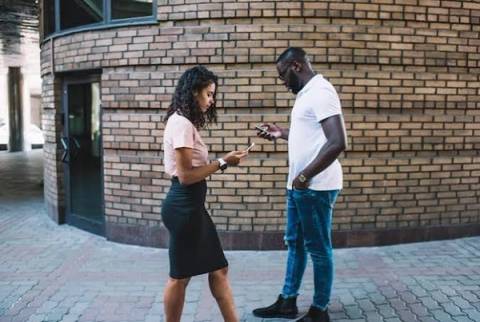

You send eleven messages this week. Two get opened. None get a reply. You didn't do anything wrong. You followed the script that supposedly works, a decent photo, an opening line that actually references her profile, no generic "hey." It doesn't matter. The silence doesn't care how good your opening line was.
The common assumption is that men have the advantage in online dating, more options, more control, more people to message. The data says almost the opposite.
The response gap nobody talks about
Pew Research Center's most recent survey of U.S. online daters, fielded in 2022, found 64 percent of men who used a dating site or app in the past year say they've felt insecure because of receiving too few messages, compared to 40 percent of women [1]. Flip it around and the imbalance holds: 54 percent of women say they've felt overwhelmed by the volume of messages they receive, compared to just 25 percent of men [1]. Men are also somewhat more likely to have tried online dating in the first place, 34 percent versus 27 percent of women [1], which means more men are competing inside a smaller share of attention than the stereotype suggests.
That's not the whole picture, and it shouldn't be treated as one. The same research shows women carry a heavier burden of harassment on these platforms, roughly two-thirds of women under 50 report experiencing at least one form of it, unwanted explicit images, being called an offensive name, threats, compared to roughly a third of men in the same age range [1]. Both of these things are true at once. Women face more volume and more harassment. Men face more silence and more rejection. Neither cancels the other out, and neither is a myth.
Dating got a lot more expensive, and men are still picking up more of the bill
A BMO Real Financial Progress Index survey of U.S. adults found the average cost of a single date reached $189 in 2026, up from $168 in 2025, a 12.5 percent jump in a single year that's running well ahead of general inflation [2]. Millennials reported spending even more, an average of $252 per date [3]. Half of Americans who date say they've gone on fewer dates or chosen cheaper activities because of the cost of living, and the average number of dates per year has slipped from roughly fourteen to twelve [2].
That cost isn't splitting evenly. A 2023 study in Psychological Reports surveying more than 550 college students found men "almost always" paid the full bill on first dates, and paid a larger share on subsequent ones, even as both men and women in the same study reported holding more egalitarian attitudes than their actual spending behavior reflected [4]. The expectation hasn't caught up to the price tag, which means the price tag mostly lands on one side of the table.
The average date now costs more than a tank of gas, and the expectation that a man pays for it hasn't gone anywhere.
The friendship collapse behind the dating stress
None of this happens in a vacuum. The Survey Center on American Life compared its 2021 national survey data to a 1990 Gallup benchmark and found the share of men reporting six or more close friends fell from 55 percent to 27 percent over that span [5]. The share of men reporting zero close friends rose from 3 percent to 15 percent, a fivefold increase, and one in five unmarried, unpartnered American men now reports having no close friends at all [5].
That matters for dating stress specifically, not just loneliness in general. A bad date or a string of unanswered messages lands differently when there's a group of close friends to shrug it off with than when there isn't one. The dating pressure isn't landing on a support system anymore. For a growing share of men, it's landing on nothing.
The economic squeeze underneath all of it
Men's labor force participation has been declining for decades, not a recent blip. It fell from 87 percent in 1948 to 75 percent by 2000 to roughly 68 percent by 2025, according to research from the American Institute for Boys and Men synthesizing federal labor data [6]. The decline is steepest among young men: workforce participation among men aged 16 to 24 dropped from 69 percent to 57 percent over the same window [6]. As of July 2026, the unemployment rate for adult men sat at 3.9 percent, slightly above the 3.7 percent rate for adult women [7]. None of this is offered as a political claim, just documented context: a $189 average date lands differently on a demographic seeing a multi-decade decline in workforce attachment, especially at the entry level, than it would have a generation ago.
What actually helps here isn't "try harder"
The advice men usually get, better photos, a sharper opening line, more effort, doesn't touch the two things the data actually points to: a response-rate problem that no amount of individual effort fixes on a platform designed to maximize engagement rather than connection, and a cost problem that keeps compounding every time a $189 dinner goes nowhere.
Compatibility-first, in-person events change both of those inputs directly. Every match is verified as mutually compatible before the event starts, so nobody's spending a week messaging into a void hoping for a reply. And the group event format spreads the cost and the emotional risk of a single night across a shared experience, rather than a string of one-on-one dinners with strangers who may not even respond afterward. It's not a fix for the friendship recession described above. But it's an evening spent around real people instead of alone, scrolling into silence.
Why this isn't a men's issue or a women's issue
The honest read of this data isn't that one side has it worse. It's that both sides are dealing with real, differently shaped versions of the same underlying failure: a dating system built on volume and guesswork instead of information. Women are managing an avalanche of low-quality attention and a real harassment problem. Men are managing a silence problem and a cost problem stacked on top of a shrinking support network. Curated, compatibility-first matching addresses the actual root cause for everyone in the room, not just one side of the table.
Take the SPARK Quiz at beyondthesparks.com. Five minutes, and it replaces the guessing with something that's actually been checked first.
We'll see you at Cabin Boys, or at Chicken N Pickle in OKC.
Sources
1. Pew Research Center, "The Experiences of U.S. Online Daters," February 2, 2023. https://www.pewresearch.org/internet/2023/02/02/the-experiences-of-u-s-online-daters/
2. BMO Real Financial Progress Index, "Date-flation Hits Hard," February 11, 2026. https://usnewsroom.bmo.com/2026-02-11-Date-flation-Hits-Hard-Average-Date-Spend-Nears-200-BMO-Real-Financial-Progress-Index
3. CNBC, "Average Millennial date costs $252," May 23, 2026. https://www.cnbc.com/2026/05/23/date-flation-average-millennial-date-costs-252.html
4. Wu, S., Luo, S., Klettner, N., White, K., & Albritton, T. (2023). Gender Roles in the Millennium: Who Pays on a Date? Psychological Reports. https://journals.sagepub.com/doi/10.1177/00332941211057144
5. Survey Center on American Life, "American Men Suffer a Friendship Recession." https://www.americansurveycenter.org/commentary/american-men-suffer-a-friendship-recession/
6. American Institute for Boys and Men, "What's Really Going On With Men and Work? Seven Facts." https://aibm.org/research/whats-really-going-on-with-men-and-work-7-facts/
7. U.S. Bureau of Labor Statistics, Employment Situation Summary, July 2026. https://www.bls.gov/news.release/empsit.nr0.htm
8. Beyond The Sparks, "We Think Real Matchmaking Shouldn't Cost $50,000." https://beyondthesparks.com/blog/matchmaking-affordability
Frequently Asked Questions
Ready to Find Your Match in Tulsa?
Take the free SPARK Quiz and join us at our next event. Everyone leaves with at least one match.
Start Your Free SPARK Quiz →