The ship felt like a floating city before I'd even found my cabin. Glass elevators. Music drifting down from a deck I hadn't found yet. A line of people at the welcome bar already laughing like old friends, four minutes after boarding.
I stood in the middle of the atrium and felt something I didn't expect: nothing. Not nerves exactly. Just flat. My jaw was tight. My eyes were doing that thing where they scan a room instead of actually seeing it. I'd spent ten years coaching people on exactly this moment, and I was standing in it feeling like a beginner.
That's the part I want to start with, because it's the part most dating advice skips. We talk about what to say. We almost never talk about what happens in your body two seconds before you say anything at all, and that's actually the part that decides how the interaction goes.
The Problem Was Never the Words
Here's the common assumption: if a room is full of new people, "confidence" is the thing that gets you noticed. Stand tall, make the joke, hold the eye contact a beat longer than feels comfortable.
Confidence gets you seen. It does not get you liked.
There's a well-known finding in social psychology that splits how we read other people into two separate tracks: warmth and competence. Warmth covers things like trustworthiness and friendliness, whether someone seems to have good intentions toward you. Competence covers capability, whether someone seems sharp or impressive. The research is clear on which one drives first impressions harder: warmth is judged faster, weighted more heavily, and it's the dimension that actually predicts whether people want to be around you [1]. Competence without warmth tends to read as cold, even threatening. Warmth without competence still reads as likable.
I had competence that week. I had the posture, the look, the practiced ease. What I didn't have, for the first hour or so, was warmth. And nobody on that ship was going to mistake one for the other.
Why Your Ego Rewrites the Story Afterward
A woman walked past early on. I noticed the opening and let it close without doing anything about it. Not dramatically. I just kept standing there, and she kept walking, and thirty seconds later my brain had already written the explanation: she looked busy. Wrong moment. I'll catch the next one.
That line, "I'll catch the next one," might be the most common sentence in modern dating. It's almost never true. It's a story your ego tells so you don't have to sit with the plainer explanation, which is that you felt a flicker of risk and your body chose safety over the moment.
There's a reason that story feels so convincing in the instant you tell it to yourself. People consistently overestimate how much others are noticing and judging them in social situations, a well-documented bias sometimes called the spotlight effect [2]. You feel exposed. You assume everyone else can see exactly how exposed you feel. In reality, almost nobody is watching that closely, which means the cost of approaching is almost always lower than it feels in the moment, and the cost of not approaching, at least to your own read on the night, is almost always higher than it feels.
I know this. I've taught this. I still did it on night one.
Warmth Is Not the Same As Being Nice
I want to be precise about what I mean by warmth, because it gets confused with being agreeable, and those are not the same thing.
Warmth is not laughing at everything because you're afraid she'll leave. It's not absorbing disrespect to keep the peace. It's not performing easygoing while quietly hoping to be chosen. Those are all forms of managing an outcome, and people can feel outcome-management even when they can't name it. A compliment that's secretly asking for reassurance lands differently than one that isn't. A question that's really a test of whether someone likes you lands differently than actual curiosity.
Warmth, the useful kind, is closer to this: you're emotionally available without needing anything back in that exact second. You're present enough to notice the person in front of you instead of narrating your own performance to yourself. You're grounded enough that their short answer doesn't knock you off balance.
That's a different skill than confidence. Confidence is about your own self-assessment. Warmth is about how available your actual attention is to the other person. You can have a lot of one and very little of the other, and I was proof of it that week.
The Moment I Actually Noticed the Shift
I didn't fix this by trying harder to be smooth. I fixed it, for about twenty minutes at a time and then lost it again, by doing something much smaller: dropping my shoulders, unclenching my jaw, and asking one real question instead of running a line.
The conversations that actually went somewhere that week started with almost nothing. A comment about which time zone we were technically in. A question about how someone ended up doing what they do for work, followed by an actual follow-up instead of a transition back to me. Small, specific, low-stakes openers, the kind that give someone room to respond instead of asking them to perform back.
What changed wasn't the script. It was whether I was actually listening to the answer or just waiting for my turn to talk again. The second one is exhausting to be on the receiving end of, even when the words are fine.
By the back half of the week, I'd stopped treating every conversation like an audition. Not because I'd gained some new technique, but because I'd caught myself often enough in the old pattern, jaw tight, eyes scanning for approval, that I could interrupt it faster each time. That's really what the whole week came down to: not becoming a different person, just getting faster at noticing when I'd left the room before my body did.
This Is the Exact Problem We Built Beyond The Sparks to Solve
Here's the thing I kept coming back to on the flight home. Almost every piece of friction I felt that week exists, in a smaller dose, at every bar, party, and app conversation most people are navigating right now. You walk into a room full of strangers, you don't know who's remotely compatible with you, and so every interaction carries this low hum of audition energy. Is this worth the risk? Am I reading this right? Should I approach, or wait?
A SPARK Quiz doesn't remove the need to show up warm. Nothing does that for you. What it removes is the first, heaviest layer of risk: not knowing whether there's any real reason to try. When you walk into a Beyond The Sparks night, you already know the room has been filtered across five real compatibility dimensions, not just by who happened to show up. That doesn't make you instantly warmer. But it does mean the warmth you do bring isn't being spent on total strangers with a near-zero chance of connecting. It's aimed at people who've already cleared the first bar.
That's the whole design philosophy, honestly. We can't coach your nervous system out of tightening up in a new room. We can make sure that when it does loosen, which it will, the person standing in front of you is someone worth it having loosened for.
What I'd Tell Someone Walking Into Their First Event
If you've been putting off your first Beyond The Sparks night because you're worried you won't be smooth enough, here's what I wish I'd told myself standing in that atrium: nobody is grading your opener. They're reading whether you're actually there with them or performing at them. Those read completely differently, even in the first ten seconds, even before either of you says anything particularly clever.
Drop your shoulders before you talk to anyone. Ask one real question and then actually wait for the answer instead of planning your next line while they're still talking. Let a silence sit for a second instead of rushing to fill it. None of that requires charisma. It requires attention, which is the one thing that's always available to you, even on a night when your confidence isn't.
What a Beyond The Sparks Night Actually Looks Like Because of This
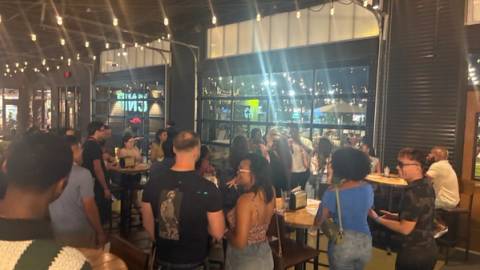
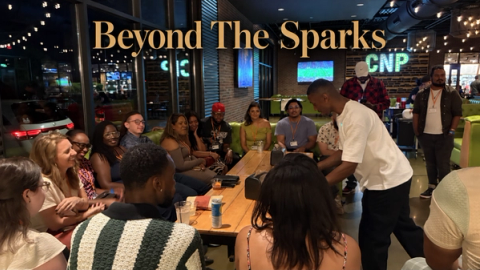
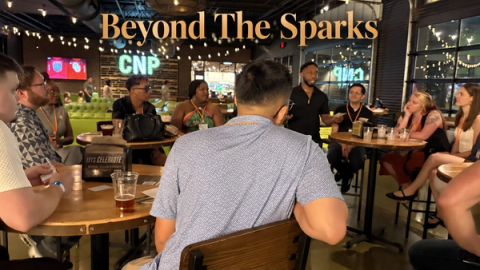
We built the Thursday night format around this exact insight, not as an afterthought but as the starting design constraint. Before anyone walks in, every guest has already taken the SPARK Quiz, a free, roughly five-minute assessment that sorts people across five compatibility dimensions, social energy style, partnership values, attachment patterns, relationship vision, and conflict and connection style. That's the part that happens before the room even opens.
What that buys you is not confidence. It buys you a room where the baseline odds are different from a random bar on a Friday. The average guest leaves with two to three real matches, and every guest leaves with at least one. That number isn't a marketing line, it's the actual guarantee, because the filtering happened before the warmth did.
I think about that cruise ship atrium a lot when I think about why that structure matters. If I'd walked into that room already knowing which five or six people there had a real shot at being compatible with me, the tightness in my jaw would have had a lot less to protect against. Most of what makes a new room feel heavy is the not-knowing. Strip out enough of the not-knowing, and warmth gets a lot easier to access, even for someone who's spent a decade teaching other people how to find it.
That's not a small design choice. It's the whole reason the format exists instead of us just running another generic mixer.
Questions Worth Asking Yourself Before Your Next Night Out
I'd push back on anyone who reads this and assumes it only applies to cruises, or to me. The pattern shows up everywhere, so it's worth checking against your own last few attempts at meeting someone new.
Where do you specifically lose warmth? Is it when the person is more attractive than you expected? When other people are around watching? When you get a short, flat answer back and immediately read it as rejection? Naming the exact trigger matters more than knowing the general concept, because the general concept is useless in the moment it actually happens.
What does your body do when that trigger hits? Does your jaw tighten. Do you stop smiling. Do you reach for your phone or a drink just to give your hands something to do. These are small, physical tells, and they're usually the first sign you've left the conversation before you've said a word indicating it.
What story does your ego tell afterward to make the retreat feel reasonable? "They looked busy." "Wrong moment." "I'll catch the next one." Sometimes that story is accurate. Often it's fear wearing the costume of good judgment, and the only way to tell the difference is to notice how often the story repeats across different people and different nights. A pattern that specific isn't bad luck.
The So What
Most dating advice optimizes for what to say. The actual lever is whether you're present enough for it to matter what you say. You can have the best opener in Tulsa and still lose the room if your jaw is tight and your eyes are scanning for the exit. Warmth is the doorway. Confidence just decides how fast you walk through it.
Take the SPARK Quiz at beyondthesparks.com. We'll see you there, and we promise nobody's grading your opener.
Sources
1. Fiske, S. T., Cuddy, A. J., & Glick, P. (2007). Universal dimensions of social cognition: Warmth and competence. Trends in Cognitive Sciences, 11(2), 77-83.
2. Gilovich, T., Medvec, V. H., & Savitsky, K. (2000). The spotlight effect in social judgment. Journal of Personality and Social Psychology, 78(2), 211-222.
Frequently Asked Questions
No. The SPARK Quiz does the compatibility filtering before you walk in, so the pressure of figuring out who's worth talking to is already handled. You just need to show up and be reasonably present.
Ask one real question and actually listen to the answer. That alone outperforms most rehearsed lines, because it signals attention instead of performance.
Yes. It starts physically, dropping your shoulders and jaw, before it's about anything you say. Most people can access it within a conversation or two once they notice when they've lost it.
Ready to Find Your Match in Tulsa?
Take the free SPARK Quiz and join us at our next event. Everyone leaves with at least one match.
Next event · Singles Event: Halloween Game Night Bash for Tulsa Singles October 30th · Friday, October 30 · Tulsa · from $25.00 Reserve →
Start Your Free SPARK Quiz →