A piece went around this fall with a title blunt enough to stop a scroll: people say they want love, apparently, just without any of the risk that comes with it. It's the kind of headline that works because it's basically impossible to argue with. Of course that's what people want. Nobody signs up for heartbreak on purpose.
We read it the way we read most dating-culture pieces that go viral, nodding at the diagnosis and then waiting for the part that explains what to actually do about it. That part never quite arrives, and it's not really a criticism of the piece. It's a structural problem with how this conversation usually gets had. We're good at naming the contradiction. We're much worse at explaining where it comes from, which means the advice that follows tends to land as a lecture: just be more vulnerable, stop being so guarded, take the leap. That's true in the way "just eat less and move more" is true about weight loss. Correct, and almost useless on its own.
So we want to take the actual thesis seriously instead of just agreeing with it from a distance, because we think it's pointing at something real, and we think the common explanation for it is wrong.
The Common Explanation Is That People Are Just Scared
The easy read on "I want love without risk" is that people have gotten soft, or avoidant, or too comfortable with the control a phone screen gives you over your own exposure. Swipe, match, chat for three weeks without ever being in a room where your face could visibly fall if it goes badly. That's a real phenomenon. It's also not the whole explanation, because it treats risk-aversion like a character flaw instead of a learned response.
Here's the data most of these pieces skip. Pew Research surveyed over six thousand U.S. adults in 2022 and found that 46% of people who've used a dating site or app describe their overall experience as negative. For women specifically, it's 51%, worse than coin-flip odds, and that negative share has climbed seven percentage points since 2019 [1]. That's not a mood. That's a track record. If roughly half of your attempts at something have gone badly, and the share getting worse over time, caution isn't cowardice. It's pattern recognition doing exactly what it's supposed to do.
People aren't avoiding love. They're avoiding a documented coin-flip.
Vulnerability researcher Brené Brown defines vulnerability precisely as uncertainty, risk, and emotional exposure [2]. Every one of those three components compounds when the thing you're exposing yourself to has a documented coin-flip-or-worse failure rate. Asking someone to "just be more vulnerable" in that environment isn't asking them to be brave. It's asking them to keep making a bet that's lost nearly half the time, without changing anything about the odds.
Attachment Theory Explains Why This Becomes a Pattern, Not Just a Mood
There's a deeper layer here that the viral-essay format rarely has room for. Attachment theory, dating back to Hazan and Shaver's foundational 1987 research, describes how early relational experiences shape a person's baseline comfort with closeness and risk [3]. People with more avoidant attachment patterns don't lack the capacity for connection. They've learned, often from real experience, that closeness has historically come with more cost than payoff, so their nervous system defaults to protecting against that cost before it happens again.
Repeated bad dating-app experiences function the same way. They're not just disappointing in the moment. Over enough repetitions, they start training the same protective reflex that early relational wounds train. Wanting love without risk, then, isn't really a refusal to be vulnerable. It's a nervous system that's done the math on the current odds and is trying to protect you from a bet that's lost before.
The Piece Gets the Diagnosis Right and the Prescription Wrong
Here's where we think the common version of this argument misses the mark. The usual prescription is to just accept more risk, to lower your guard and trust the process. That's true in the abstract. It's also exactly the advice that's hardest to follow when the actual, lived data on the process is a near coin-flip.
The real lever isn't asking people to tolerate more risk. It's reducing how much risk is actually required to find out if something's worth it. Those are different problems with different solutions, and conflating them is why so much dating advice feels like it's blaming the person for a system that's genuinely working against them.
Think about what makes risk feel survivable in any other context. A risk feels worth taking when you have real information going in, not perfect certainty, but a meaningfully better-than-random signal that this specific bet is more likely to pay off than the last nine didn't. Nobody tells a day trader to just stop being risk-averse. You give them better information, and the risk tolerance follows naturally, because the risk itself has actually changed.
What This Looks Like When You Build It Into an Actual Room
This is the part we think about constantly, because it's the entire premise behind why Beyond The Sparks exists instead of us just telling people to download another app and try harder.
A SPARK Quiz doesn't remove risk from meeting someone. You still have to show up, still have to be the one who starts the conversation, still have to be the one who might not click with the person across the table. What it changes is the information you're carrying into that risk. You're not walking into a room of total strangers at roughly coin-flip odds of even having anything in common. You're walking into a room that's already been filtered across five real compatibility dimensions before you arrived.
That doesn't eliminate the vulnerability. It makes the vulnerability worth spending. There's a real difference between being scared to be vulnerable with someone who has a fair shot at being right for you, and being scared to be vulnerable with a stranger your app matched you with largely because you were both within driving distance and roughly the same age. The first fear is just nerves. The second fear is accurate risk assessment, and no amount of "just be braver" talk fixes an accuracy problem.
Why Surface-Level Filtering Doesn't Actually Fix This
It's worth being specific about why this isn't solved by the filtering apps already claim to do, age range, distance, a couple of stated interests. Research on compatibility science, including work by psychologists Paul Eastwick and Eli Finkel, has repeatedly found that people are remarkably bad at predicting, in the abstract, which traits in a partner will actually produce attraction and connection once they meet someone in person [4]. Stated preferences on a profile, the things apps filter on, correlate weakly with who people actually end up connecting with face to face.
That's a real problem for the "just get better information" argument, because the obvious response is that dating apps already give you information, and it clearly isn't solving this. The distinction that matters is what kind of information. Age, height, and a six-word bio aren't the information that predicts compatibility. The dimensions that actually seem to matter, how someone handles conflict, what they want long-term, how they give and receive closeness, are almost never captured by a swiping profile, and they're exactly the kind of information that requires a deeper assessment than a dating app's business model is built to collect.
This is also why we don't think the answer is eliminating risk altogether, which would be a different mistake in the other direction. Some uncertainty is just inherent to meeting another human being, and trying to engineer it down to zero would mean engineering out the actual humanity of the interaction along with it. The goal isn't a world with no risk. It's a world where the risk you're taking is pointed at genuinely better odds than a coin flip, so that when it doesn't work out, it doesn't carry the particular sting of having been predictable from the start.
What Better Odds Actually Look Like in Practice
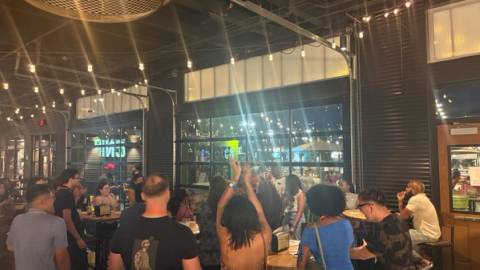
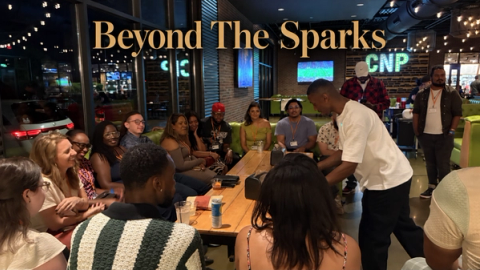
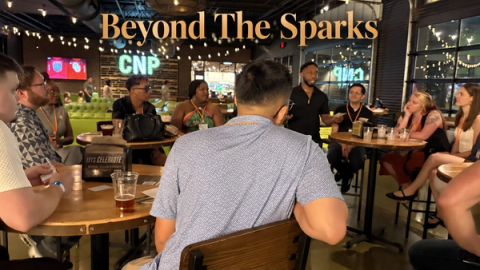
It's easy to talk about "reducing risk" in the abstract and harder to point at what that actually means in a real room, so here's the concrete version. At a Beyond The Sparks night, every guest has already completed the SPARK Quiz before arriving, which sorts people across five real compatibility dimensions rather than the surface filters an app uses. The event's match guarantee means every guest leaves with at least one genuine match, and the average is two to three. Those aren't abstractions. They're specific, checkable claims about how the odds change once the filtering happens before the vulnerability does, instead of after.
Compare that to the modal first date sourced from an app, where two people are meeting almost entirely on the strength of a few photos and a short bio, with no real signal yet on whether their values, conflict style, or relationship vision line up at all. The risk in that scenario isn't lower just because it started on a screen instead of in person. It's often higher, because the screen creates an illusion of vetting that the underlying data, Pew's 46% negative-experience rate among them, suggests isn't actually happening in any meaningful way.
We see the same pattern whether it's a Thursday night in Tulsa or a Chicken N Pickle night in OKC. The venue changes. The underlying mechanism doesn't. Filter first, then let the vulnerable part happen in a room where it's actually got a reasonable shot of mattering.
So What Does the Original Question Actually Get Wrong?
The viral framing treats "love without risk" like a contradiction people need to be talked out of. We'd argue it's not a contradiction at all. Nobody wants risk for its own sake. What people actually want is enough signal that the risk they're being asked to take has a realistic shot at paying off. That's not a character flaw. That's how every rational person evaluates any bet in their life, and dating is not a special exception where that instinct suddenly becomes cowardice.
The fix isn't convincing people to want risk more. It's building environments, rooms, formats, matching systems, where the risk that's left over is actually proportionate to the odds. That's a logistics and design problem, not a courage problem, and it's solvable in a way that "just be more vulnerable" never quite is.
The So What
People aren't avoiding love. They're avoiding a documented coin-flip. Fix the odds, not the person.
Take the SPARK Quiz at beyondthesparks.com. We built the whole format around making the risk worth taking more often than not, not around pretending the risk isn't there at all.
Sources
1. Pew Research Center. (2023, February 2). The Experiences of U.S. Online Daters. pewresearch.org/internet/2023/02/02/the-experiences-of-u-s-online-daters/
2. Brown, B. (2012). Daring Greatly: How the Courage to Be Vulnerable Transforms the Way We Live, Love, Parent, and Lead. Gotham Books.
3. Hazan, C., & Shaver, P. (1987). Romantic love conceptualized as an attachment process. Journal of Personality and Social Psychology, 52(3), 511-524.
4. Eastwick, P. W., & Finkel, E. J. (2008). Sex differences in mate preferences revisited: Do people know what they initially desire in a romantic partner? Journal of Personality and Social Psychology, 94(2), 245-264.
Frequently Asked Questions
Not quite. Most people want vulnerability to pay off more often than chance. The aversion is to bad odds, not to risk itself.
It reduces it concretely, by filtering who's in the room before you ever have to be vulnerable with them, rather than leaving that filtering to chance or an algorithm optimizing for engagement over fit.
Pew's research shows the negative-experience share has risen since 2019, especially among women, which tracks with increasing app fatigue, more unwanted contact, and larger, less-curated user pools.
Ready to Find Your Match in Tulsa?
Take the free SPARK Quiz and join us at our next event. Everyone leaves with at least one match.
Next event · Singles Event: Halloween Game Night Bash for Tulsa Singles October 30th · Friday, October 30 · Tulsa · from $25.00 Reserve →
Start Your Free SPARK Quiz →