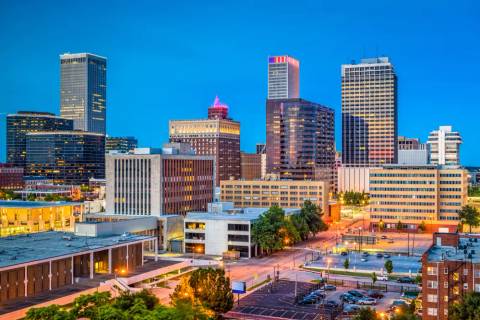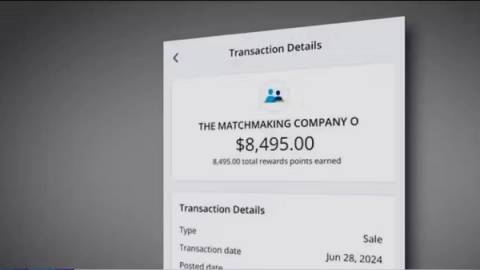

She moved to Tulsa eight months ago for ten thousand dollars and a spare bedroom she could turn into a home office. The job stayed the same, still remote, still logging into the same laptop for the same California company. What changed was everything outside the laptop. No office. No built-in coworkers to grab lunch with. No college friend group within five hundred miles. Just a new city, a nice check, and the quiet realization that nobody actually tells you how you're supposed to meet people when your entire job happens inside four walls.
The common read on Tulsa Remote is that it's an economic development story, a clever way to pull remote workers and their salaries into a city that wanted the tax base. That's true, and it's also an incomplete way to describe what actually happens to thousands of people who take the deal.
What Tulsa Remote actually is
Tulsa Remote, funded by the George Kaiser Family Foundation, pays qualifying remote workers ten thousand dollars to relocate to Tulsa [1][2]. To qualify, applicants generally need to be adults working remotely for an out-of-state employer, or self-employed with mostly out-of-state clients, and agree to actually relocate within a set window after acceptance. It is not a vague relocation incentive. It is a real, structured program that has been running since 2018.
More than 3,400 people, and counting
A technical research report from the Upjohn Institute, economist Timothy Bartik's study on the program's effects, puts total Tulsa Remote participants at more than 3,400 since the program launched [3]. That number was independently covered by Bloomberg in 2025, which found the program returns more than four dollars in local economic benefit for every dollar spent [1]. That is not a rounding error in a city Tulsa's size. It is a real, sustained pipeline of newcomers, arriving specifically because they were paid to, landing in neighborhoods across the metro with no existing local network waiting for them.
Scale that against a city where most people's social circles were built in high school, at church, or through a decade of the same local job, and the shape of the problem becomes obvious. Every single one of those 3,400-plus people arrived starting from zero, socially, in a city that mostly isn't used to absorbing that many newcomers at once.
Who's actually moving here
The demographic profile behind that number matters, even though it's pieced together from a few different sources rather than one single canonical breakdown. CNBC's coverage of a 2023 cohort of Tulsa Remote participants who relocated from California described a group overwhelmingly in their late twenties through forties, established in their careers, choosing Tulsa specifically for the combination of cash incentive and lower cost of living [4]. Brookings' research on the program found participants saw a real, measurable increase in disposable income after the move, evidence that this isn't a population scraping by, but one with genuine financial stability [5]. The most common origin states, going back to the program's earliest coverage, include California, Texas, New York, and Colorado, a genuinely national pool of newcomers, not a regional one [1][4].
A city can add thousands of well-educated, prime-age newcomers and still not have solved the actual problem those newcomers are quietly dealing with: how do you meet anyone when your job doesn't put you in a room with other people anymore?
That age range sits directly inside prime dating years, and that income and education profile describes exactly the kind of person who could, in theory, be a strong match for plenty of Tulsa's existing single population. The theory and the reality don't automatically connect on their own, though.
The part nobody's actually covered
Here's something worth being direct about. Major coverage of Tulsa Remote, and there's real coverage, Bloomberg, CNBC, research out of Brookings and McKinsey, has focused almost entirely on the program's economics: relocation costs, retention, tax impact, what it means for Tulsa's workforce [1][3][5][6]. None of the coverage we could find has examined what the program does to a newcomer's actual social and dating life once the moving truck leaves.
That's not us claiming outside reporting backs up a dating-scene narrative. It doesn't, not yet. This is our own observation, made from actually running events in this city and meeting Tulsa Remote participants who show up to them. We're naming a real gap in the existing coverage, not citing research that has already closed it.
And the gap is a real one. A traditional corporate relocation, the kind that sends someone to a new city for an in-office job, comes with a built-in social starter kit: coworkers, a breakroom, a first-week orientation full of other new hires in the exact same position. Tulsa Remote explicitly doesn't work that way. The entire premise of the program is that the job stays remote. There is no office to walk into. The thing that would normally solve half of a newcomer's social problem was designed out of this particular relocation from the start.
Being honest about what we don't know
We should be direct about the limits of the available data too. There is no official Tulsa Remote breakdown of single versus partnered participants that we could locate, and we're not going to invent one. The program doesn't track or publish that, at least not publicly, and pretending otherwise would be exactly the kind of unsourced claim this brand doesn't make.
What we do know is the shape of the population: prime dating age, highly educated, financially stable, arriving in a city where their existing social network is, almost by definition, back in California or Texas or New York. Whether any individual Tulsa Remote participant is single is something only they know. Whether the program as a whole has created a meaningfully larger pool of newly arrived, socially disconnected adults in their thirties is not really in question.
Retention, and why it actually strengthens the case
Brookings' research on the program directly compared people who actually moved through Tulsa Remote against a similar group who applied but didn't relocate, and found the program's participants were significantly more likely to still be living in Tulsa well after their program year ended, a real, measured staying effect rather than a one-year experiment most people abandon [5]. Retention figures vary somewhat across different reports and cohorts, but the consistent finding is the same: most people who take the deal are still here.
That's a meaningful detail for anyone wondering whether this population is worth building anything around. A newcomer who leaves after eight months is a different social problem than one who's still here in three years, still working the same remote job, still without the built-in social infrastructure a traditional relocation would have provided.
Why a compatibility-first model fits this specific gap
This is exactly the kind of gap Beyond The Sparks was built to close, and it's a sharper version of the same problem we described when we announced our Bentonville expansion. A remote worker who relocated for Tulsa Remote doesn't even have the fallback a Bentonville transplant has, a physical office full of coworkers to slowly build friendships with over lunch breaks. There's no slow, accidental path to meeting people built into the job itself.
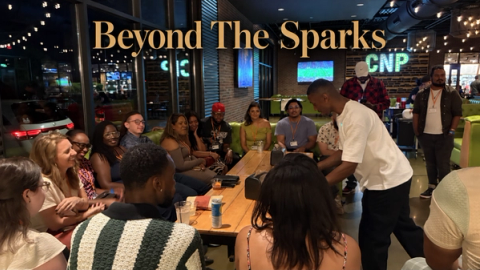
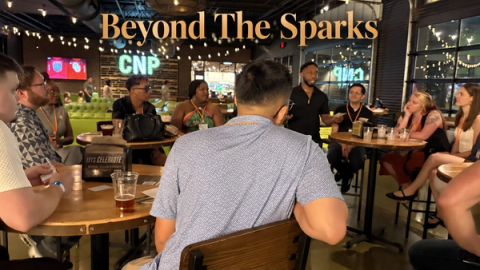
The free SPARK Quiz doesn't care whether you moved here for a paycheck, a job, or because you grew up three blocks from where we host our events. It sorts everyone the same way, across social energy style, partnership values, attachment pattern, relationship vision, and conflict or connection style, and the event is where that filtering turns into an actual room full of people. For someone whose entire social starter kit got left behind in another state, a single Thursday night can do more social work than eight months of remote log-ins ever could.
The coworking space isn't a full substitute
Tulsa Remote's model does include real infrastructure aimed at exactly this gap, a dedicated coworking space and a calendar of community events built specifically to give participants some version of the office they gave up [6]. That's a genuine, thoughtful piece of program design, and it's better than nothing by a wide margin. It's also not the same thing as an office.
An office puts the same group of people in the same building five days a week, for years, with no opt-in required. A coworking space and a community events calendar require someone to actively choose to show up, repeatedly, to a room that isn't guaranteed to have the same faces in it from one week to the next. That's a real structural difference, not a minor one. The first kind of social contact happens by default. The second kind requires ongoing effort from someone who, by definition, doesn't yet know anyone in the room.
That's not a criticism of the coworking model. It's a reasonably good answer to a hard problem. It just means the gap this piece is describing doesn't fully close on its own, even with a well-designed program actively trying to close it.
What this looks like in practice
If you moved to Tulsa through the program, or you're a longtime local who's noticed the city filling up with new faces at the coffee shop that used to be half-empty, the underlying situation is the same. Tulsa's population of prime-age, well-educated, newly arrived adults has grown by thousands of people over the past several years, and very little of the infrastructure around that growth has specifically addressed how those people are supposed to date.
That's not a criticism of the program itself. Tulsa Remote was built to solve an economic problem, and by most available measures, it's solving it. It was never designed to solve a social one, and there's no reason it should have to. That's a different piece of infrastructure entirely, and it's the piece we're actually built for.
It's worth saying plainly that this isn't only a Tulsa Remote story either. The same pattern shows up anywhere remote work lets someone relocate on their own terms, without a job pulling them physically into a shared building. Tulsa just happens to be the city running the most visible, well-documented version of that experiment, with real published research behind it, which makes it a genuinely useful lens for a problem that's actually much bigger than one program.
None of that requires knowing whether you personally came here through the program, know someone who did, or have never heard of Tulsa Remote before reading this. The underlying situation is the same either way: a city with more newly arrived, socially disconnected adults in their prime dating years than it's had in a long time, and not nearly enough built specifically to help them meet each other.
Take the SPARK Quiz at beyondthesparks.com. Whether you got here for the paycheck or you've been here your whole life, it works the same five minutes either way.
We'll see you there.
Sources
1. Bloomberg, "Tulsa Remote Worker Program Reaps More Benefits Than Costs, Study Finds," May 29, 2025. https://www.bloomberg.com/news/articles/2025-05-29/tulsa-remote-worker-program-reaps-more-benefits-than-costs-study-finds
2. CNBC, "Tulsa, Oklahoma Will Pay You $10,000 to Move There and Work From Home," November 13, 2018. https://www.cnbc.com/2018/11/13/tulsa-oklahoma-will-pay-you-10000-to-move-there-and-work-from-home.html
3. Bartik, T. J. (2025). The Effects of Tulsa Remote on Inducing Moves to Tulsa. W.E. Upjohn Institute for Employment Research. https://research.upjohn.org/cgi/viewcontent.cgi?article=1055&context=up_technicalreports
4. CNBC, "These Californians Moved to Tulsa to Work Remotely," December 28, 2023. https://www.cnbc.com/2023/12/28/these-californians-moved-to-tulsa-to-work-remotely.html
5. Brookings Institution, "Work From Anywhere as a Public Policy: Three Findings From the Tulsa Remote Program." https://www.brookings.edu/research/work-from-anywhere-as-a-public-policy-three-findings-from-the-tulsa-remote-program/
6. McKinsey & Company, "Tulsa's Innovative Program Supports Remote Workers and Economic Development." https://www.mckinsey.com/featured-insights/future-of-work/tulsas-innovative-program-supports-remote-workers-and-economic-development-through-covid-19-and-beyond
7. Beyond The Sparks, "Why We're Bringing Beyond The Sparks to Bentonville, Arkansas." https://beyondthesparks.com/blog/beyond-the-sparks-bentonville-arkansas
Frequently Asked Questions
A program funded by the George Kaiser Family Foundation that pays qualifying remote workers $10,000 to relocate to Tulsa, running since 2018.
More than 3,400 as of the most recent Upjohn Institute research, independently covered by Bloomberg in 2025.
Yes — Brookings research found participants were significantly more likely to still be living in Tulsa well after their program year ended compared to a similar group who didn't relocate.
No official breakdown exists publicly, and this post doesn't claim one does.
Ready to Find Your Match in Tulsa?
Take the free SPARK Quiz and join us at our next event. Everyone leaves with at least one match.
Next event · Singles Event: Halloween Game Night Bash for Tulsa Singles October 30th · Friday, October 30 · Tulsa · from $25.00 Reserve →
Start Your Free SPARK Quiz →